Where do you look for a rainbow on a black tea bowl? In the color photograph of Niji (虹, “Rainbow”), follow the diagonal where the black glaze meets the dark brown. The seam turned silver in the kiln and gave the bowl its name. This Chinese bowl is an example of haikatsugi tenmoku. It appears in our practice notes for dai tenmoku, the tea procedure in which the bowl is handled on a stand. Color photograph of Niji, Cultural Heritage Online
A handbook for the Muromachi shoguns’ reception rooms gave first place to yōhen bowls, with their star-like markings, and second place to yuteki, or oil-spot bowls. A tea master writing in the time of Sen no Rikyū began his account of tenmoku with the kind of bowl Niji belonged to. And at one tea gathering in Nara, the record tells us which haikatsugi bowl the host chose and what he set beside it.
Reading the old photograph of Niji
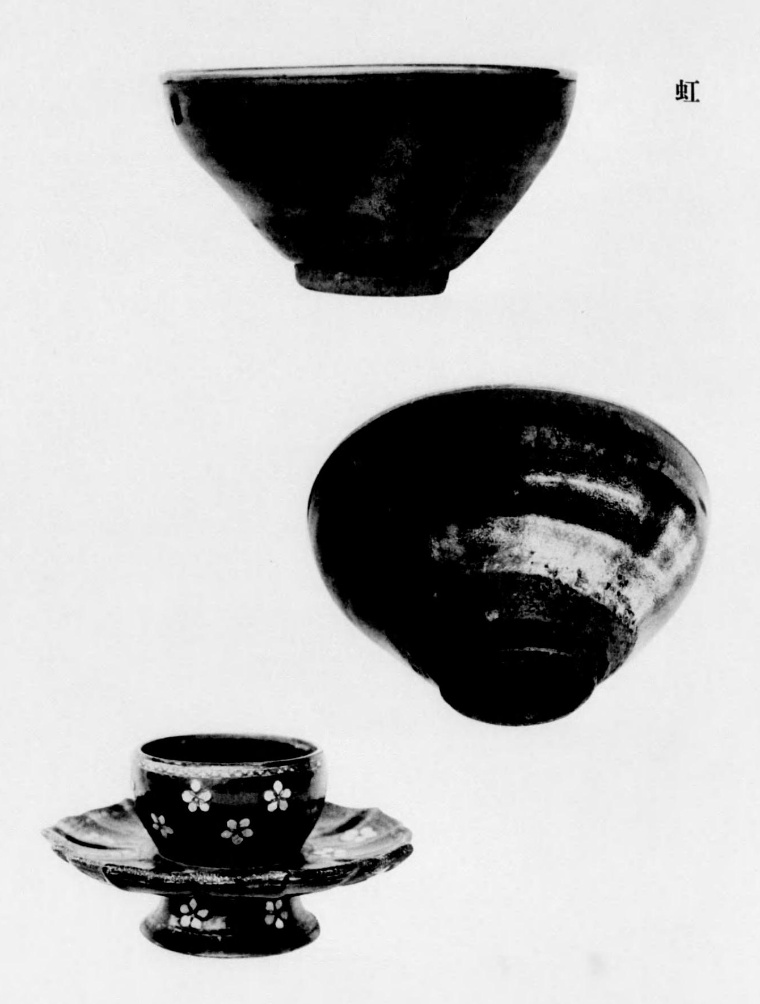
The haikatsugi bowl Niji and its stand. Black-and-white plate from Takahashi Yoshio’s Taishō meikikan, vol. 6, with the margins cropped. National Diet Library Digital Collections, frame 53
In the top photograph, the sides flare from a narrow foot to a wide mouth. In the middle view, the foot faces the camera and a pale band runs across the body. Haikatsugi means “ash-covered.” It describes a family of bowls whose glaze can look dusted with ash. Each has its own markings. Niji names the one in the photograph. The Agency for Cultural Affairs on Niji’s glaze
The bottom photograph shows the stand handed down with the bowl. Its black lacquered rim is shaped like petals, and the plum blossoms on its surface are inlaid shell. The bowl is the older of the two. The Agency for Cultural Affairs dates it to China’s Yuan dynasty and the stand to the sixteenth century, during the Ming dynasty. Cultural property record for the bowl and stand
What counted as tenmoku in the shogun’s handbook?
The Kundaikan sōchōki explains how to display paintings and utensils in the Muromachi shoguns’ reception rooms. A manuscript in Tohoku University’s Kanō Collection preserves a colophon dated 1511. In the section on ceramics, the writer sees stars of several colors against the black of a yōhen bowl. For yuteki, the detail worth looking for is the spotting on both the inside and the outside. The descriptions give readers a way to recognize the bowls for themselves. Tohoku University Library manuscript record · Transcription of the ceramics section, p. 24
Today, tenmoku can include both yōhen and yuteki. In this manuscript, “tenmoku” has a heading of its own, further down the list, with a narrower meaning. Within that group the writer rates haikatsugi highly. Even so, the handbook rules them out when choosing a bowl for the shogun himself. The judgment depended on which bowls the writer was comparing and whose room they were for. Katō’s discussion of the categories, pp. 24–25
Two utensils on a round tray in Nara
At midday on the twenty-ninth day of the second month of Tenshō 4 (1576), Tsuda Sōgyū attended a tea gathering at Shishōbō, a temple residence at Tōdaiji in Nara. The Taishō meikikan, a catalogue compiled in the early twentieth century, quotes the record of that day’s utensils. It names another haikatsugi bowl, Sekiyō (夕陽, “Setting Sun”). The temple associated with Niji had a second bowl with a name of its own. Catalogue entry for Sekiyō, vol. 6, p. 44, upper right
The catalogue entry for the tea caddy lets us reconstruct the arrangement. It names a katatsuki and the Sekiyō tenmoku, and says the two were set on a round tray. A katatsuki is a tea caddy with pronounced shoulders. This one survives at the Idemitsu Museum of Arts under the name Shishōbō (師匠坊). In the museum photograph you can see its broad mouth and square shoulders, and picture Sekiyō beside it, raised on its stand. Catalogue entry for the Shishōbō caddy, vol. 1, p. 114, upper right · Photograph of the tea caddy, Idemitsu Museum of Arts
Twelve years later, Rikyū’s pupil Yamanoue no Sōji wrote about tenmoku. The copy of the Yamanoue Sōji ki held at Omotesenke’s Fushin’an bears a colophon dated 1588. Sōji begins by naming prized haikatsugi bowls one by one, including one that belonged to the tea master Takeno Jōō. He adds that haikatsugi could be found in many places and that some were finer than others. Where the shogun’s handbook gives the single category haikatsugi, Sōji gives his readers enough detail to distinguish one person’s bowl from another’s. Omotesenke’s manuscript · Transcription of Sōji’s passage on tenmoku, p. 25
The day Niji changed hands
What can we trace of Niji itself? The Agency for Cultural Affairs records a tradition that the shogun Ashikaga Yoshimasa owned it. The handbook tells us how his household displayed its treasures, but it gives us no account of Yoshimasa handling this particular bowl. A much later deed names Niji and explains why one owner gave it to another. The Agency’s provenance record
In a deed dated 1742 and reproduced in the Taishō meikikan, Furukawa (古川大和大掾) traces Niji from Shishōbō at Tōdaiji through another temple residence (成福院) and into his own hands. He addresses the deed to his creditor (松谷可十郎). Unable to repay a loan, he is handing over the bowl. He begins by identifying Niji in its pouch of old gold brocade on a white ground. At the close he takes care to say again that he is handing over both the bowl and its pouch. Opening of the deed, p. 47, lower half · Date and addressee, p. 48, upper half
A list of utensils for tea practice can fit “haikatsugi tenmoku, Niji” on a single line. Each name answers a different question. Haikatsugi tells you what to look for in the glaze. Niji lets you follow one particular bowl, down to the white pouch that changed hands with it. See Niji in the sample utensil list for dai tenmoku