Five packets of a tea called Hatsu-mukashi, picked on the sixteenth day of the third month. Five more of Ato-mukashi, picked the following day. An 1833 record from Uji, near Kyoto, lists both teas in a single jar. Whoever received it could tell which teas were inside, how much of each there was, and who had packed them. All they had to do was lift the lid of the wooden box that held the jar. Uji City Historical Museum, Kataoka family papers, p. 15
Pasted to the underside of the box lid was an iri nikki (入日記), the tea maker’s inventory. The paper seal across the mouth of the jar could stay intact until kuchikiri, the tea gathering at the beginning of winter when the host broke the seal and ground the leaves for the guests. Kanbayashi Shunshō on the jar and its inventory · Omotesenke on the opening of the tea jar
The white packets beside the jar
The small ceramic caddy a host uses for thick tea holds powdered matcha. The shogun’s household sent much larger jars, called chatsubo, from Edo to Uji to collect tencha, the leaves from which matcha is ground. Toshikura Moritsune accompanied the procession in 1810 and wrote a guide for his successors. The party left the jars with the tea makers in Uji, then returned for two days of packing. Urasenke’s guide to tea utensils · Iwase Bunko Library on Toshikura’s journey · The itinerary in the library catalogue
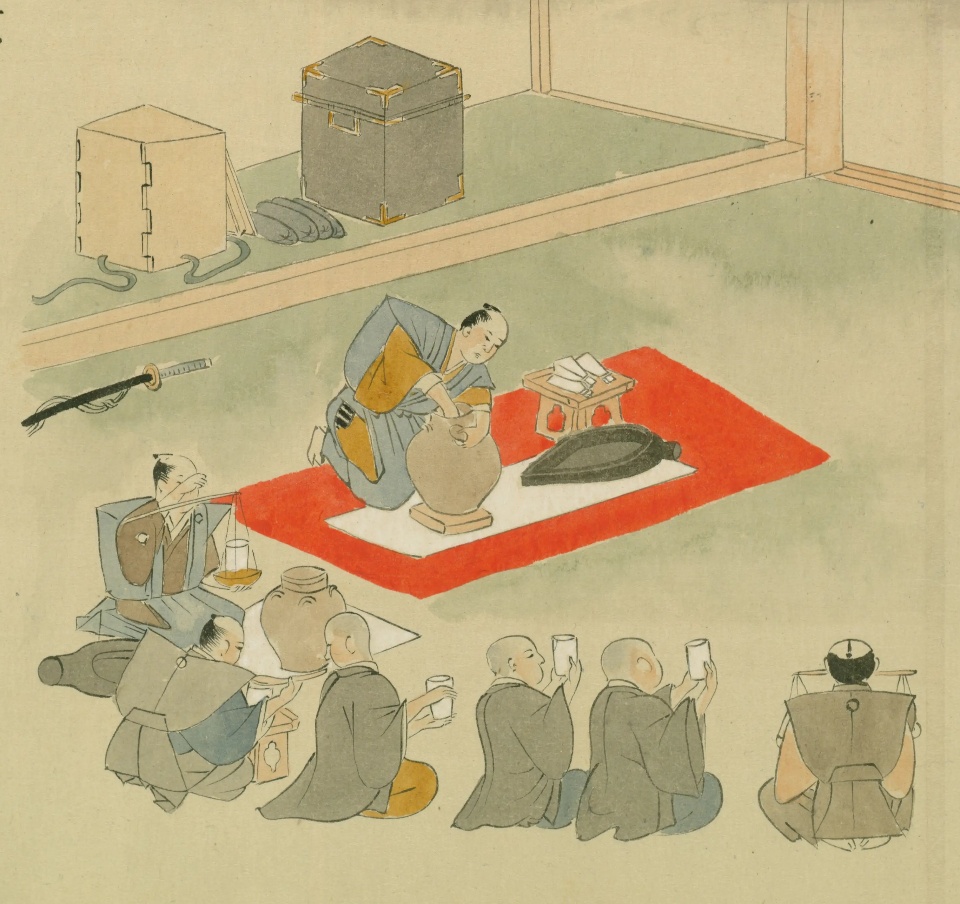
Packing tea for the shogun’s household. Detail from the scroll Ochatsubo no maki, attributed to Kanō Tomonobu after an original by Awataguchi Keiu. National Diet Library Digital Collections, frame 20
Look at the stand beside the kneeling man. The little white packets give a sense of how several teas could travel together. The Kanbayashi Shunshō family describes folding bags from Mino paper and writing the tea’s name on each one. The family calls a packet a hantai, or “half bag.” Its name recalls a change in the amount packed. A portion that once weighed twenty momme was divided into two packets of ten momme each. The Kanbayashi family’s account and photographs of tea packing
The packets held leaves for koicha, thick tea. Around them the tea maker packed loose leaves for usucha, thin tea. Those loose leaves were called tsumecha. Once the lid was on, the tea maker pasted paper over the mouth of the jar and stamped it with a seal. The names on the packets were now hidden inside. Urasenke Tankōkai’s Hokkaido youth group on the two teas · Kanbayashi on sealing the jar
Seven tea names in one jar
For a packing list we can actually read, turn to a different customer. The Kataoka Dōji family kept a ledger of the tea it supplied to the Asano lords of Hiroshima. Its 1833 ledger includes a copy of a jar inventory, headed 御茶入日記写. On printed page 15 of the museum’s transcription, look for the large box in the middle of the page. The vertical columns read from right to left. The museum’s introduction, p. 5 · The boxed inventory, p. 15
The entry 半三拾 gives the total of thirty half bags. Moving left, you can match each tea name to the number beneath it. Hatsu-mukashi (初昔) and Ato-mukashi (後昔) account for five packets apiece. The next five entries are 一文し (3), 初鷹爪 (3), 大祝白 (4), いノ白 (5), and ろノ白 (5). Together the seven counts come to thirty. The next quantity, 拾斤, changes the unit. It means ten kin, a measure of weight for the loose leaves surrounding the packets. The dates beside the first two teas are picking dates in the calendar then in use. The inventory itself ends with a date in the sixth month and the packer’s name, Kataoka. Tea names, weights, and signature, p. 15
What did the loose tea cost?
Beside the inventory, a note originally written in red gives the prices. The first two teas had one price per packet, the other five a lower one. The loose tea sold by the kin. Here momme measures the weight of silver due in payment. The price note and receipt, p. 15
| Tea | Quantity × rate | Silver (momme) |
|---|---|---|
| Hatsu-mukashi and Ato-mukashi | 10 packets × 7.5 | 75 |
| The other five named teas | 20 packets × 3.9 | 78 |
| Loose tea marked 別儀 | 10 kin × 52 | 520 |
| Total | 673 |
The receipt on the same page gives the tea charge for this jar as 673 momme of silver. All thirty carefully labeled packets together cost 153 momme. The leaves poured into the spaces around them accounted for the remaining 520.
At a tea gathering, a guest can ask the host for the name of the tea and who supplied it. For a bowl of Hatsu-mukashi from this jar, the answer to the second question is still there in the signature, Kataoka. The inventory even tells us something a guest might never hear. All five packets came from leaves picked on the sixteenth day of the third month. Asking about the second bowl in a two-tea service