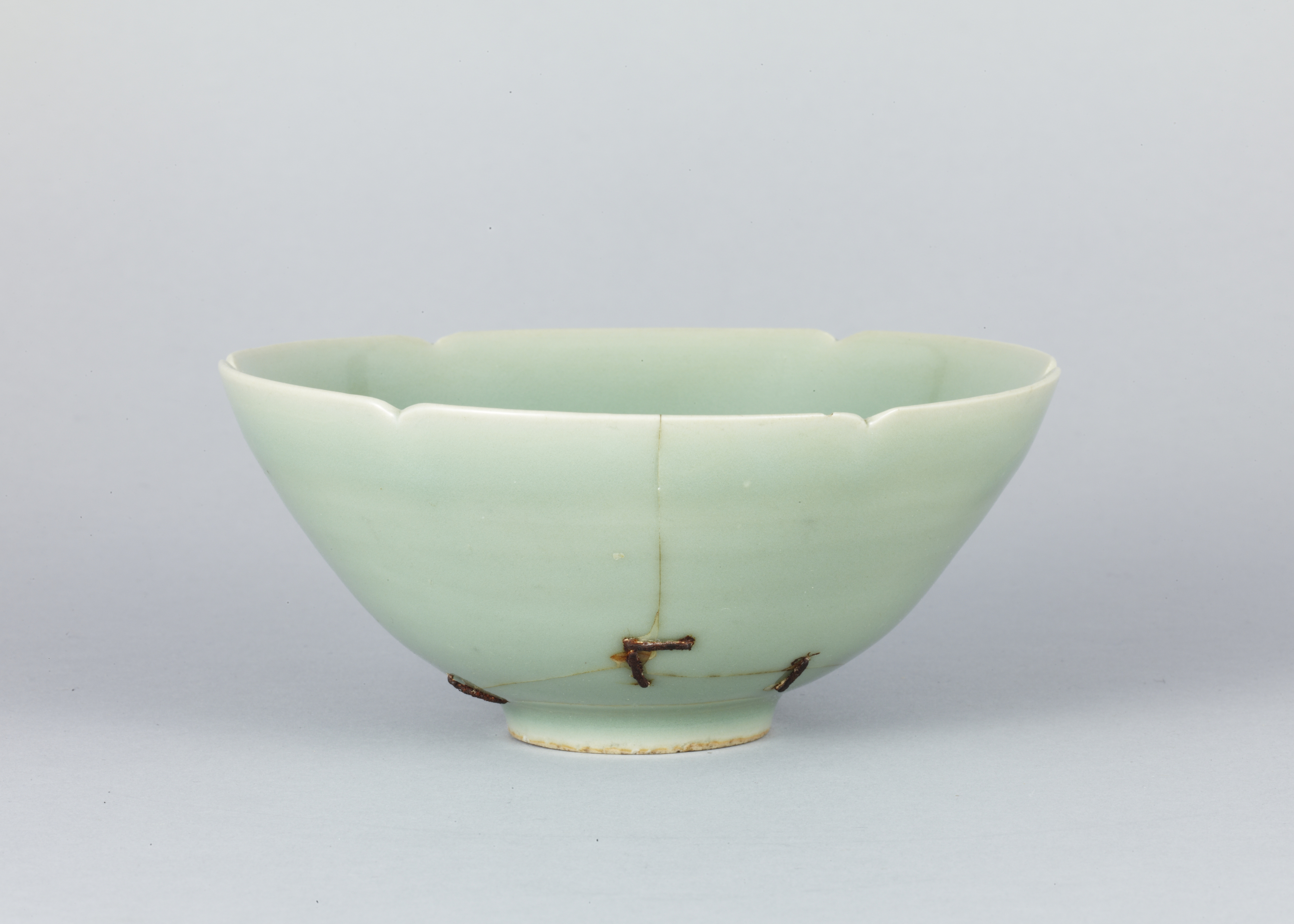
A hairline runs down the front of a pale green bowl. At its lower end sits a little bar the colour of rust. This is Bakōhan, a Southern Song celadon from the Longquan kilns in China, now an Important Cultural Property at the Tokyo National Museum. The bar is an iron staple. Its ends disappear into the ceramic on either side of the crack, holding it closed. The museum’s collection record · Yukiko Iwao on ceramic staples
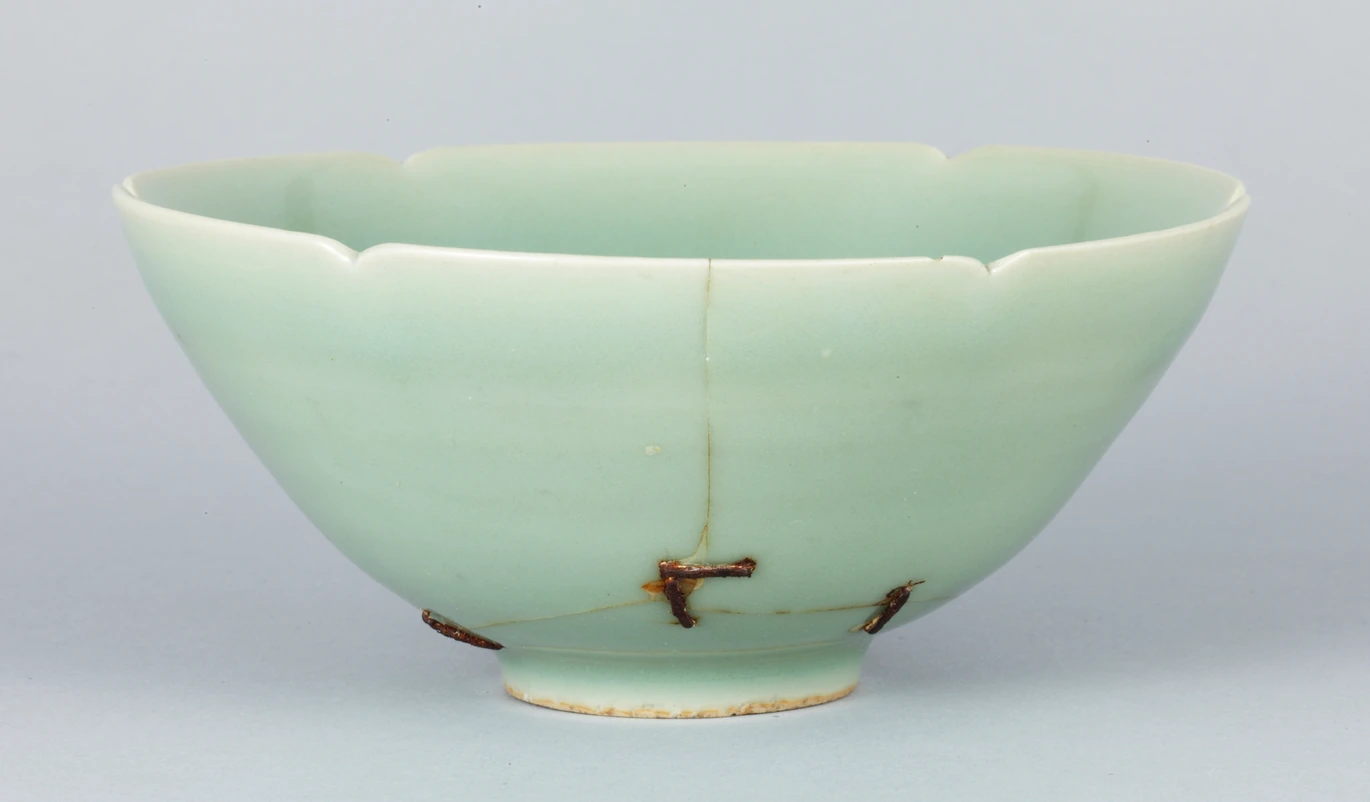
The original. Six shallow notches divide the lip like the edges of petals. Look just to the right of the notch at the front for the fine crack crossing the rim. Original photograph, Tokyo National Museum, ColBase
In nineteenth-century Kyoto, potters of the Takahashi Dōhachi family deliberately incised that crack in new clay. On two tea bowls they fitted real iron staples. On a smaller cup, a few strokes of gold stand in for the iron. Set the four vessels together and the repair tells you which particular green bowl they all refer to. National Institutes for Cultural Heritage, descriptions of the three copies
Turn the bowl over and count the staples
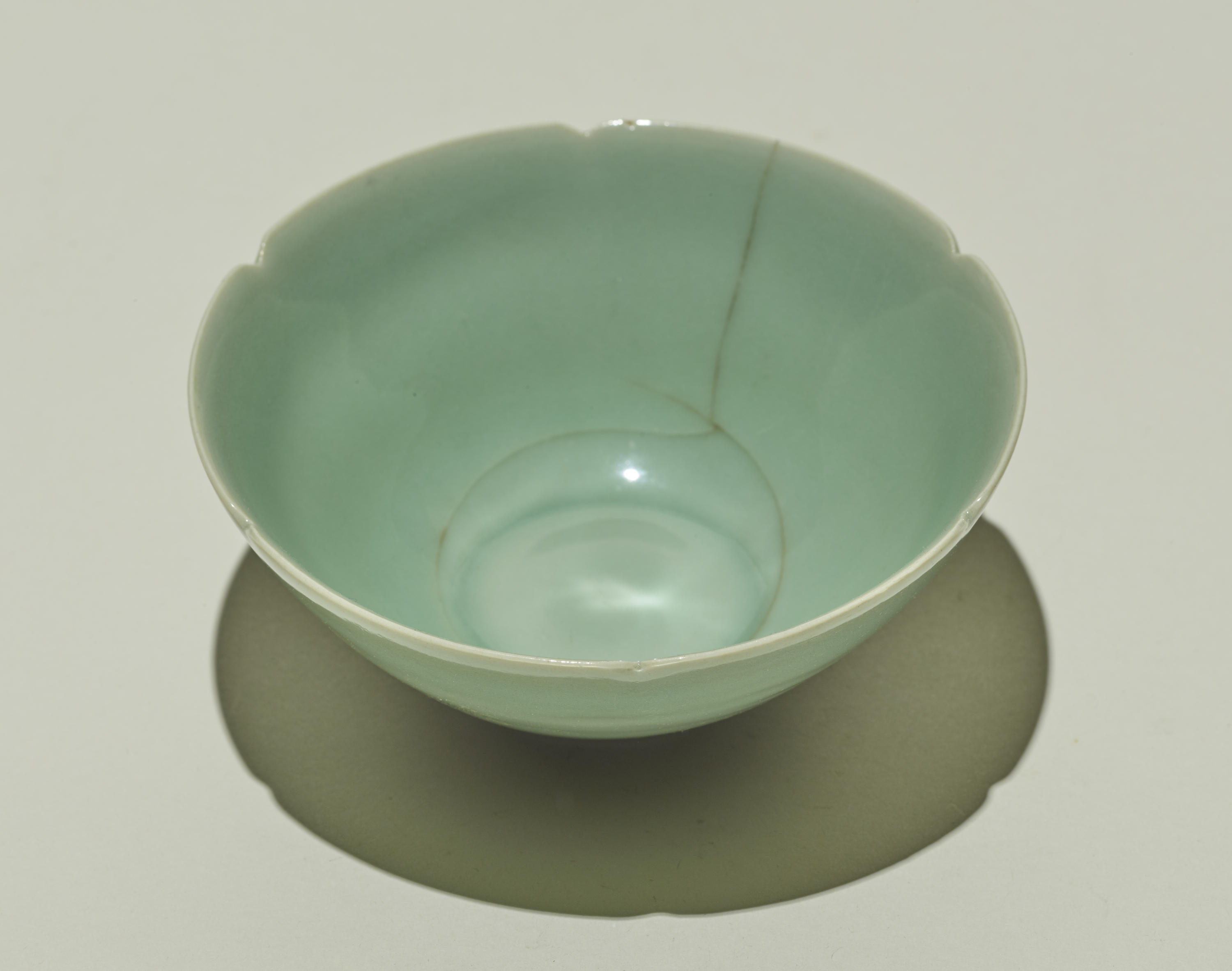
First look inside. A crack runs around the bottom. A single branch climbs from that ring to the lip. No metal shows on this side. The pattern suggested to the curator Atsushi Imai that the damage may have occurred when someone poured boiling water into the bowl. His evidence was the way the crack ran. There is no eyewitness account of the accident. Imai’s examination of Bakōhan
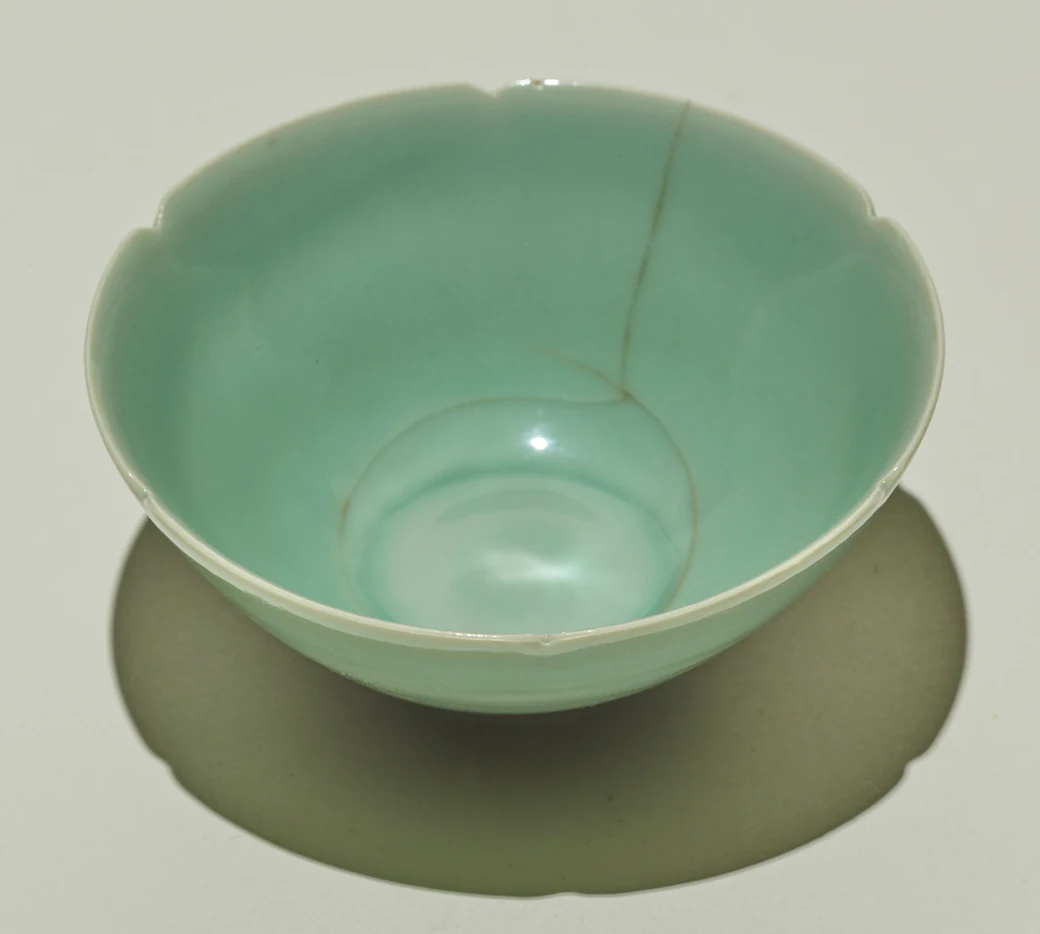
Follow the line from the rim to the ring inside. Interior photograph, ColBase
Turn the bowl upside down. The ring runs around the outside of the foot, the raised circle on which the bowl rests. At the front one staple crosses the upright crack and another crosses the crack running around the vessel. They almost make a right angle. Those two and three more, spaced apart, make five visible in this view. Imai counted six pieces of iron on the bowl itself. The government designation record says it is secured in six places. Imai’s count · National cultural property record
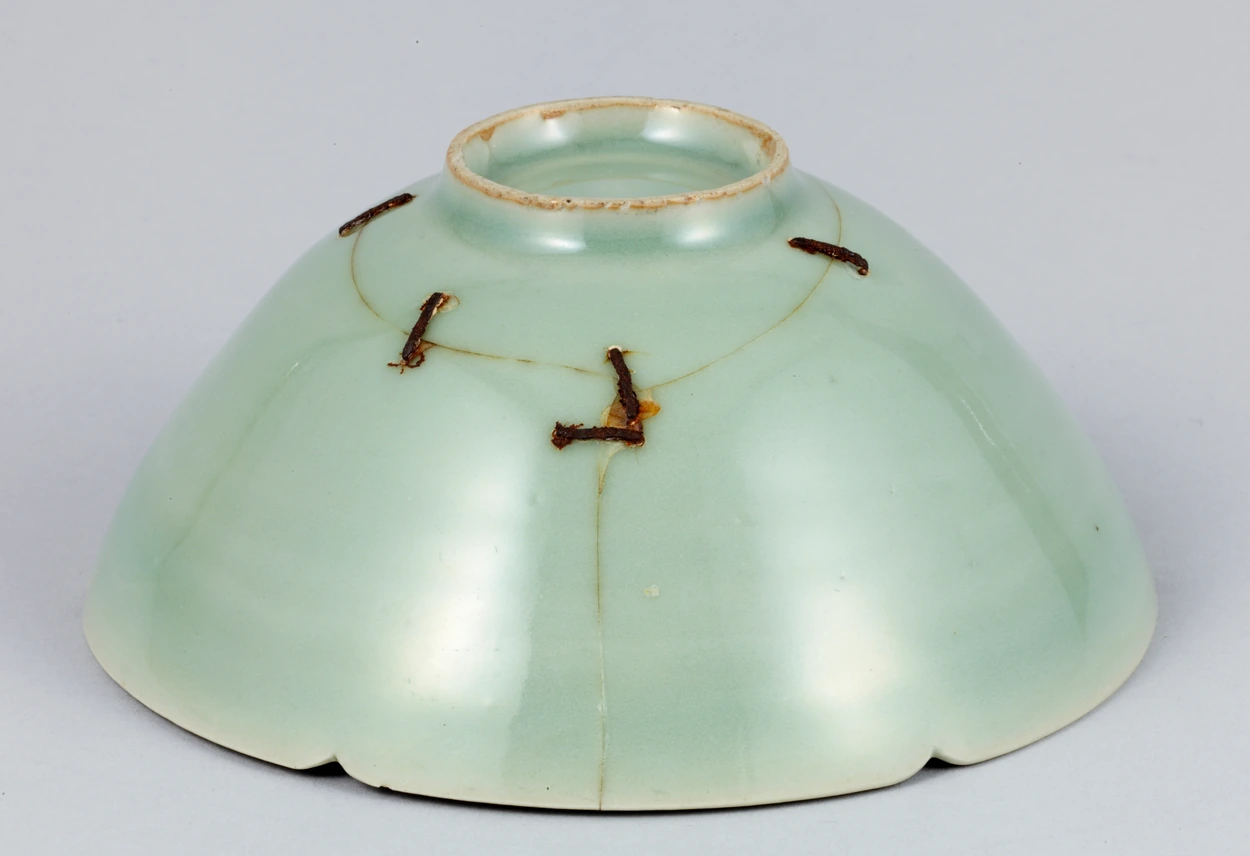
At the junction of the two cracks, each staple bridges a line running in a different direction. Underside of the original, ColBase
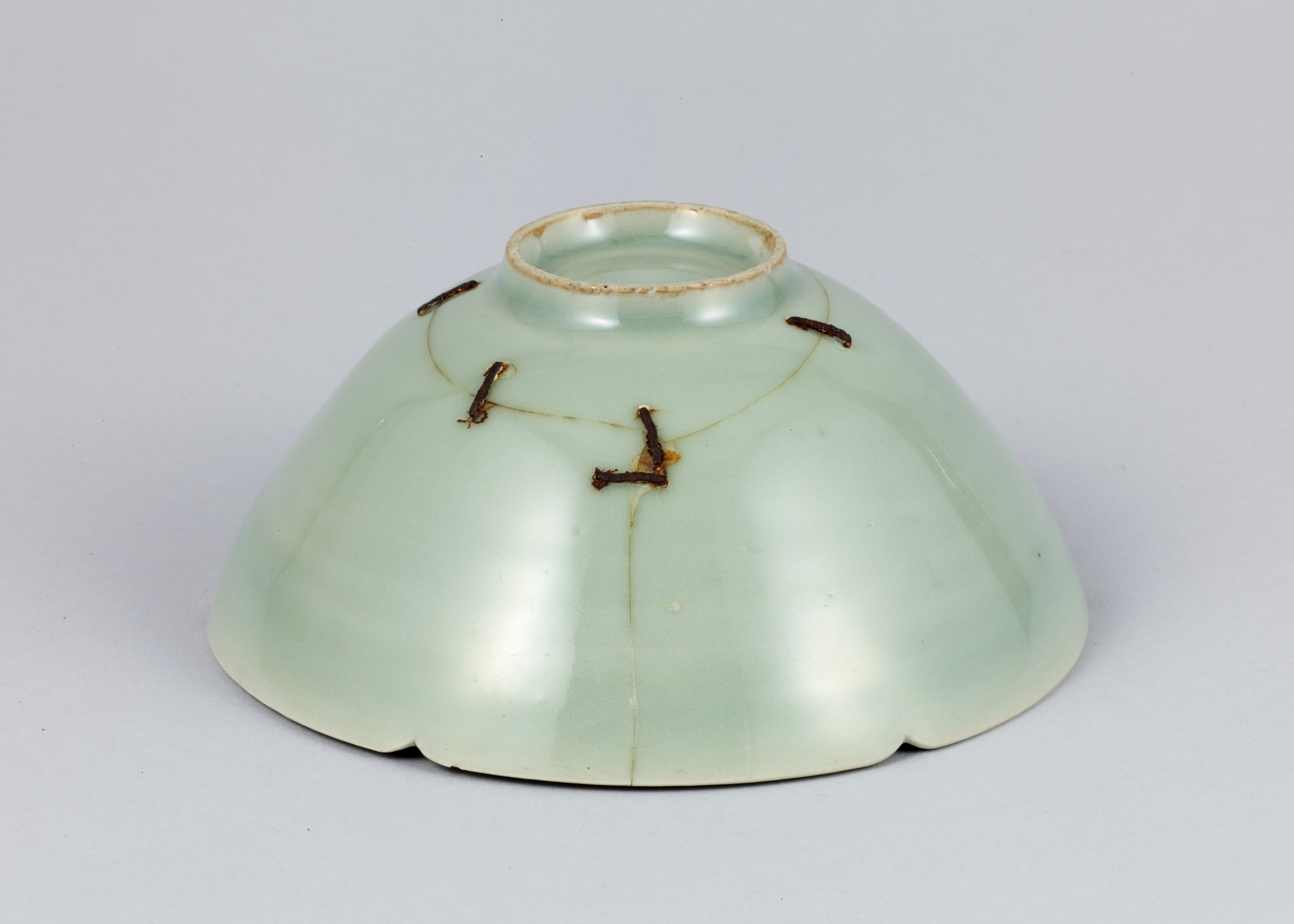
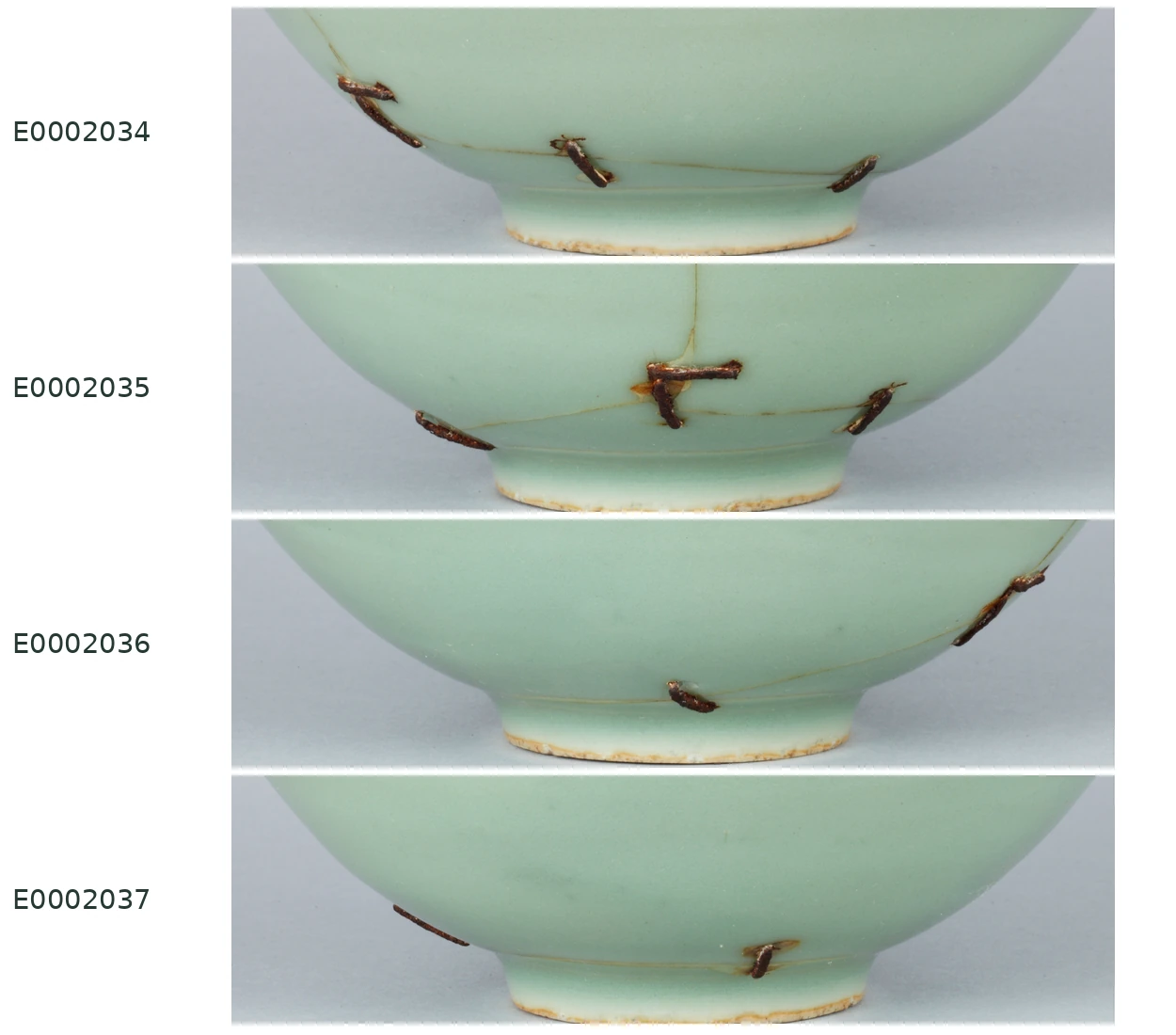
Use the corner made by the pair as a landmark. The first three photographs show it repeatedly as the viewpoint changes. The last shows another side. Four original views, ColBase
On 28 June 1920, Takahashi Yoshio, also known as Sōan, handled this very bowl at the home of Mitsui Takayasu. His examination as printed in the Taishō meikikan says “five places.” He also published an underside photograph taken from another angle. Counting the two close staples as one location would reconcile the figures, but Takahashi never explains his count. And the government record explicitly says six places. A number visible in one photograph, a count of the pieces of iron and a count of locations are three different observations. Takahashi’s examination, vol. 6, p. 114 · Designation record
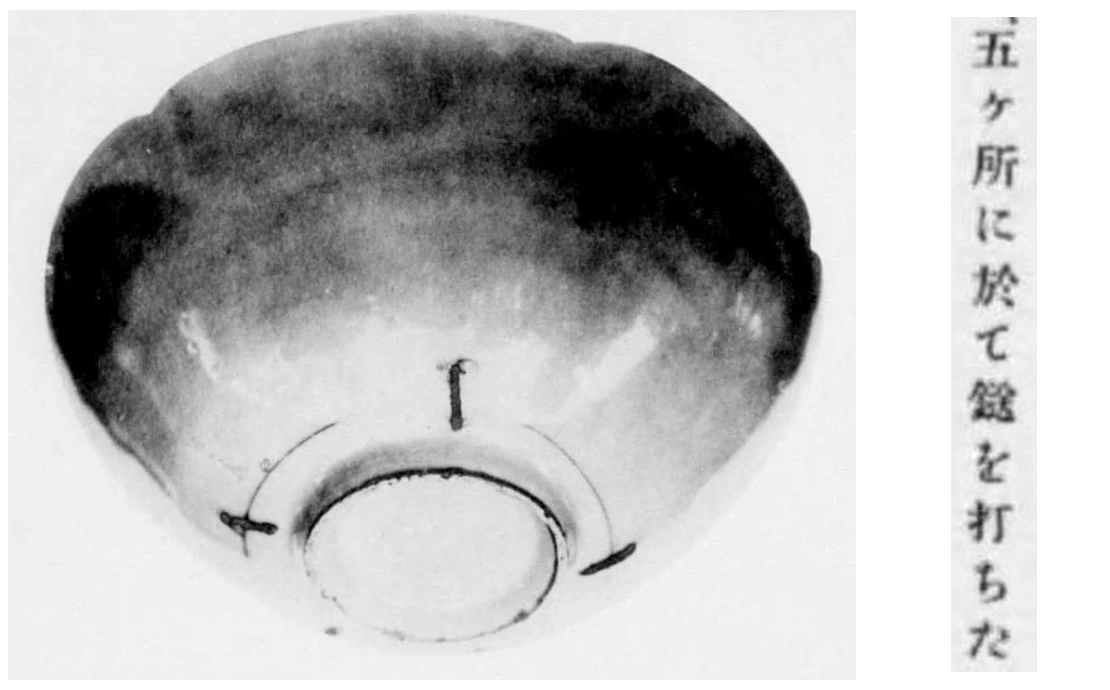
Published in 1925. The photograph at left comes from p. 112 and the enlarged passage at right from p. 114. Photographic page · Written examination, National Diet Library
How father and son made the cracks and the iron
The two Kyoto tea bowls both have the six-lobed lip and the line circling the base. The museum’s annual report explains how the potters did it. They incised the paths of the original cracks into the surface, then fitted six iron staples to each bowl. Damage acquired by the Song bowl thus became something to build into a new one. By this time, patrons were ordering copies of famous tea utensils from Kyoto workshops. Museum annual report, p. 9 · Suntory Museum of Art on Dōhachi’s copies
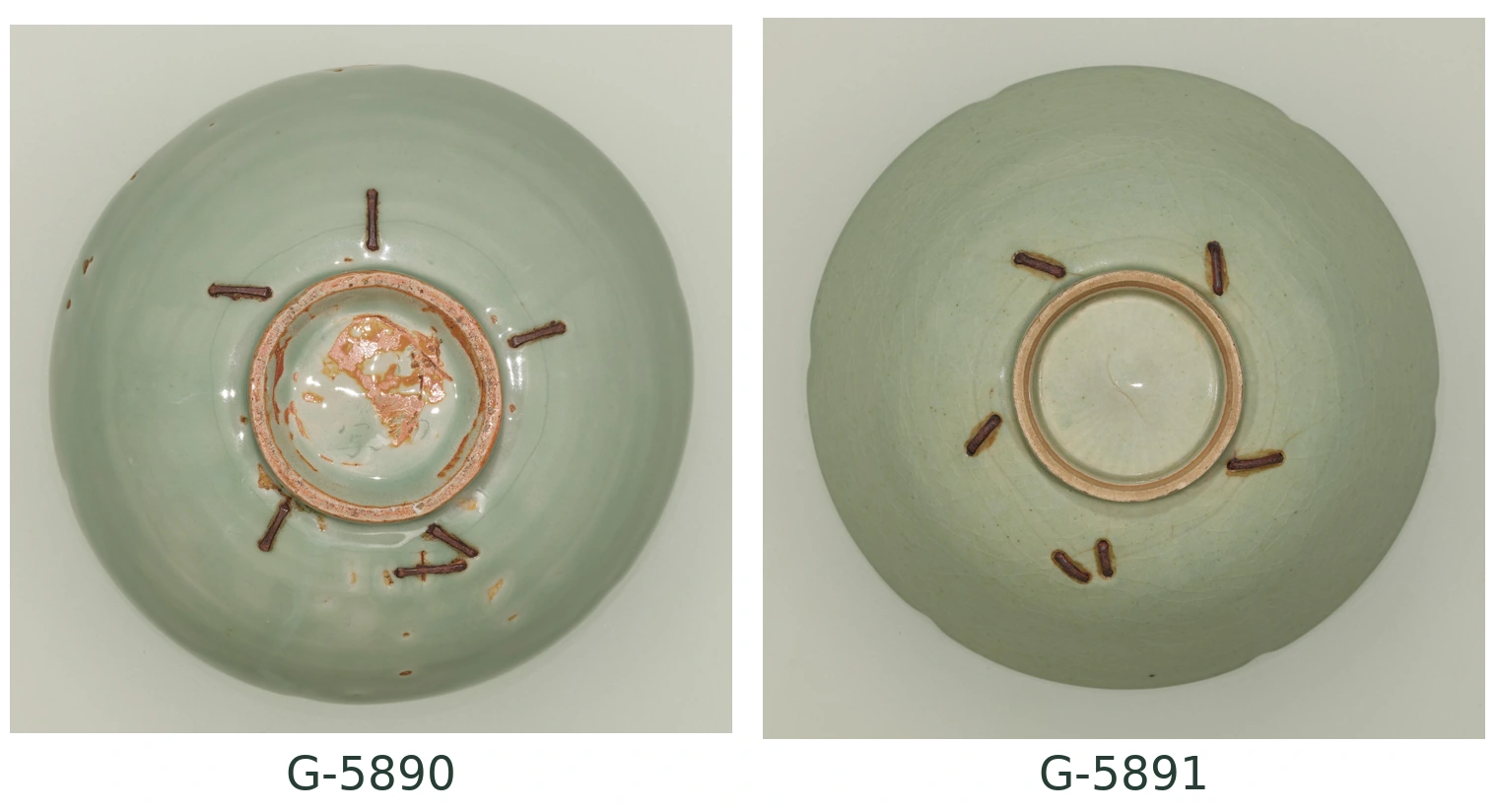
Left, Ninnami Dōhachi, or Takahashi Dōhachi II, G-5890. Right, his son Takahashi Dōhachi III, G-5891. Look inside the ring of the foot to tell the bowls apart. Left-hand bowl · Right-hand bowl, ColBase
The bowl on the left is 15.0 cm across. Brown clay shows through inside its foot, where the potter cut the inscription 御物写, identifying it as a copy. The other measures 15.3 cm and is glazed inside the foot. Turn them upright. The central depression where tea settles is shallow on the left, sharply defined on the right. The fine, ice-like web on the right belongs to the glaze. The long line the potter cut to represent a particular fracture has quite a different origin. Annual report on the feet and interiors · Current catalogue entry for G-5891
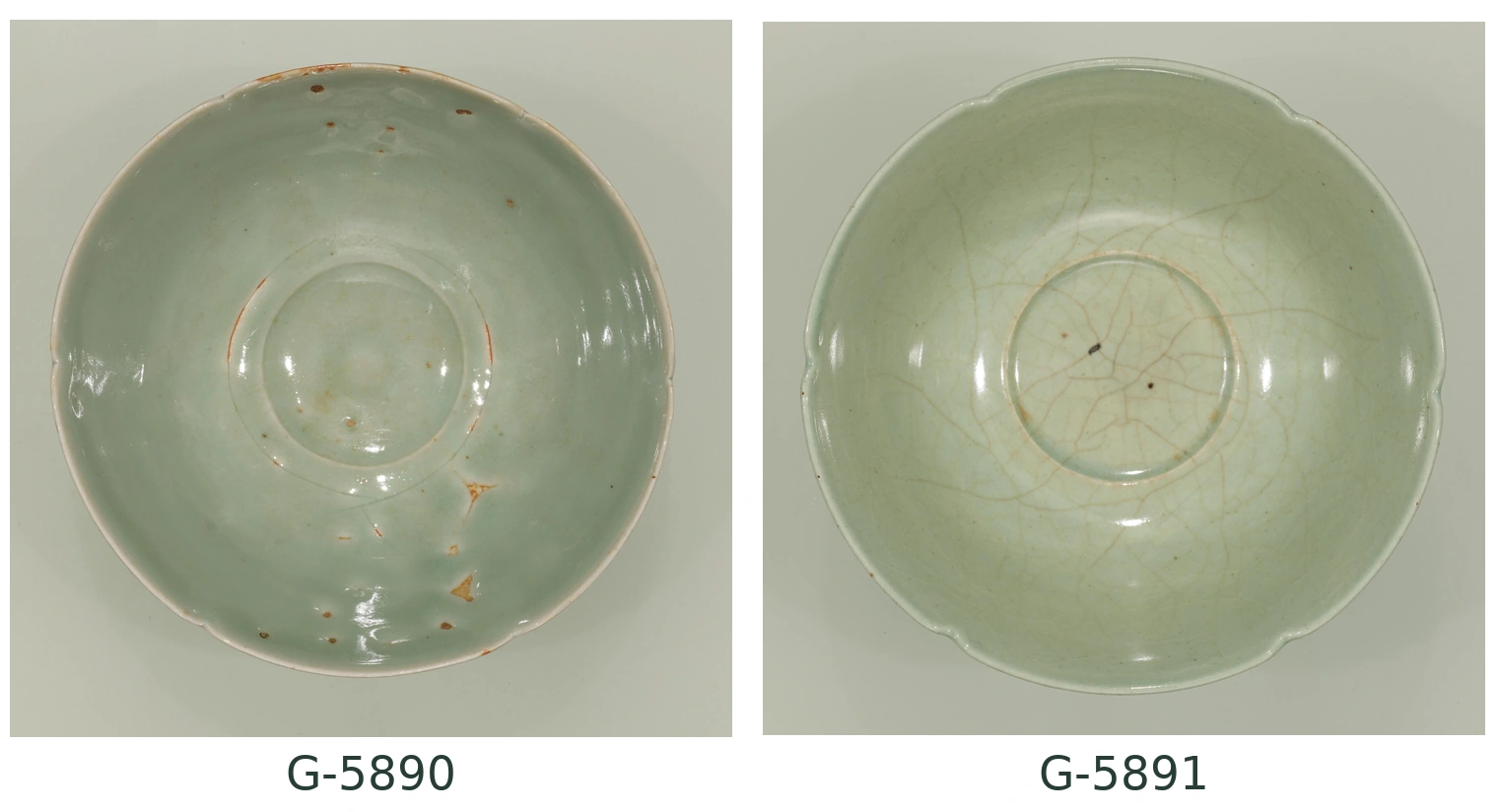
Same order as the undersides. In the right-hand bowl, compare the stronger line crossing the central well with the fine network around it. Dōhachi II · Dōhachi III, ColBase
There is a reason to keep the collection numbers in view. The museum’s 2021 fiscal-year report tentatively assigned all three copies to Dōhachi II. Its current catalogue and Yukiko Iwao’s 2025 study attribute the right-hand bowl to his son, Dōhachi III. The captions here follow the current catalogue. Annual report · Maker field for G-5891 · Iwao, fig. 4
What survived when the bowl became a sake cup?
The other work by Dōhachi II measures just 6.6 cm across. That is three-sevenths of the original’s 15.4 cm. A wash of gold at the lip suggests a fine metal binding. Inside the cup and around its foot, incisions trace the old cracks. For the staples, the potter turned to gold paint. The lobed cup, G-5889 · The museum’s technical description
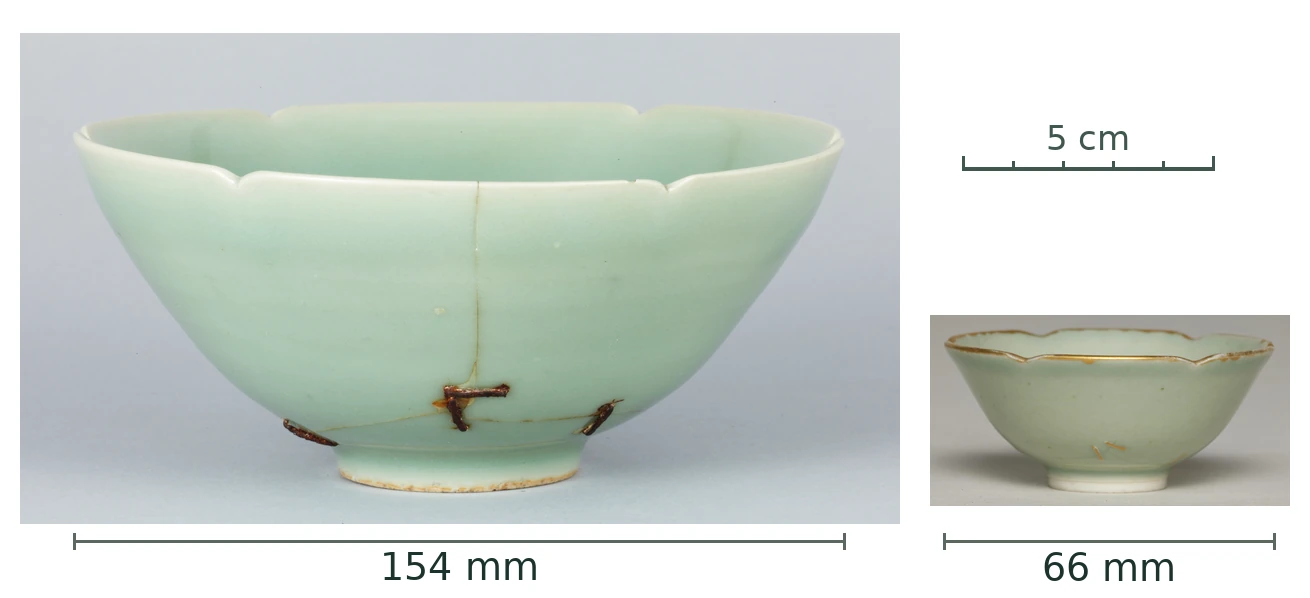
The photographs were scaled by rim width. The camera angles differ. The designation record gives the original as 15.0 cm. We use 15.4 cm from ColBase to compare all four vessels from one catalogue. Original · Cup · Designation measurements
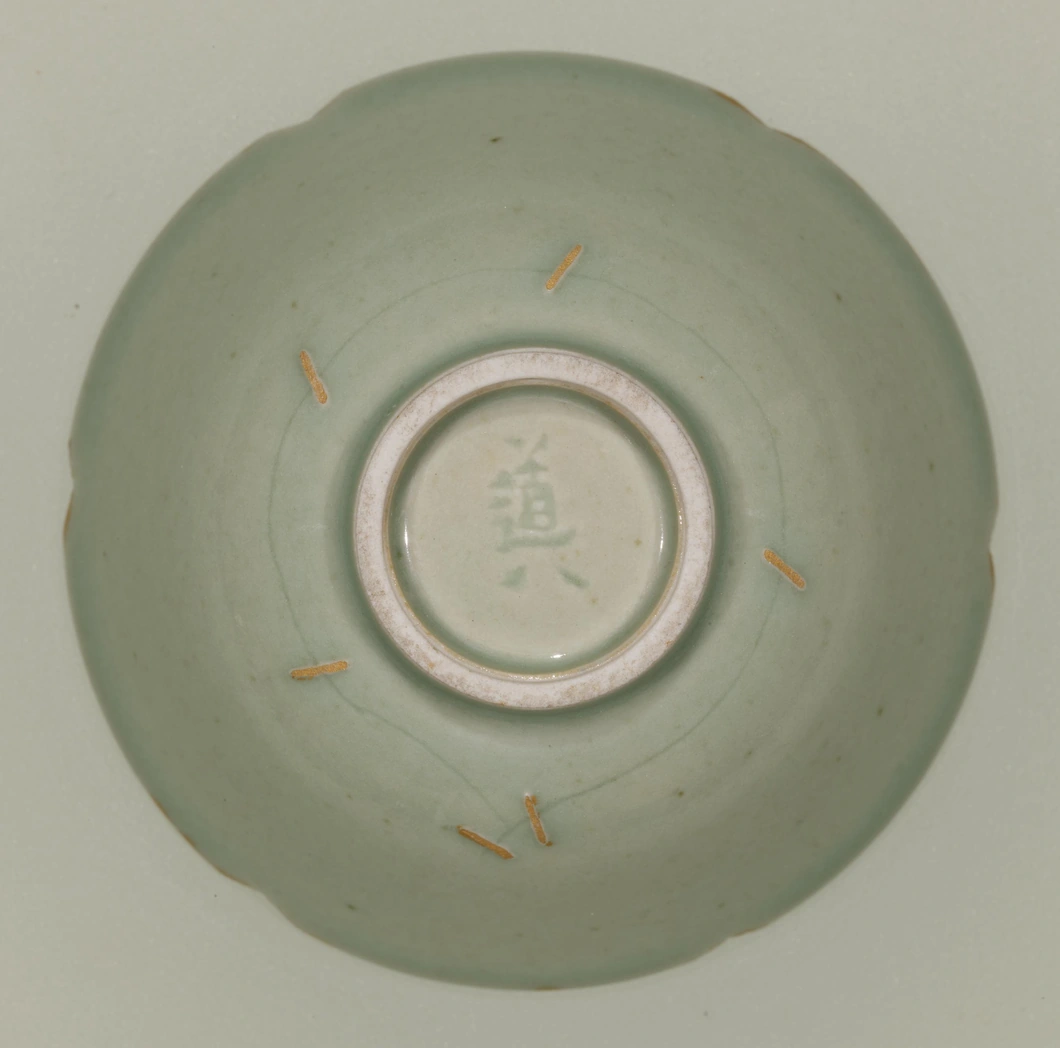
Find the pair at six o’clock, then the other four strokes farther apart. Just a few millimetres of gold describe the familiar corner. Enlarge the underside, ColBase

In a gold-lacquer repair, the gold can draw the eye along a join. Here the brush makes short strokes across the incisions. It depicts the piece of hardware that bridges each crack. Two box lids tell us what Dōhachi called the vessels. On the round lid he wrote 馬蝗絆茶甌, the Bakōhan tea bowl. The small cup’s lid reads 霽青馬蝗絆 with a large 巵, a character for a sake cup. The width, use and feel of the iron have all changed. The place where the two staples meet has survived. Tea bowl inscription · Cup inscription · Dictionary entry for 巵
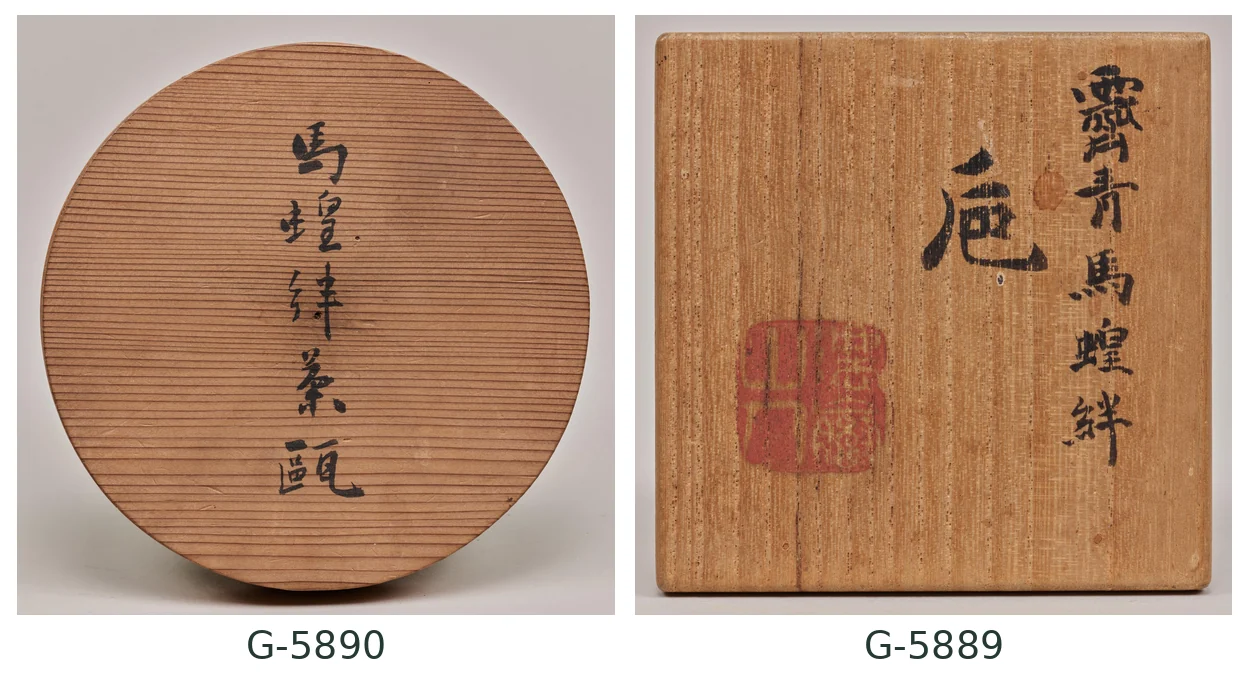
The Tokyo National Museum attributes both inscriptions to Dōhachi II. The lids have been sized for reading. Tea bowl lid · Sake cup lid, ColBase

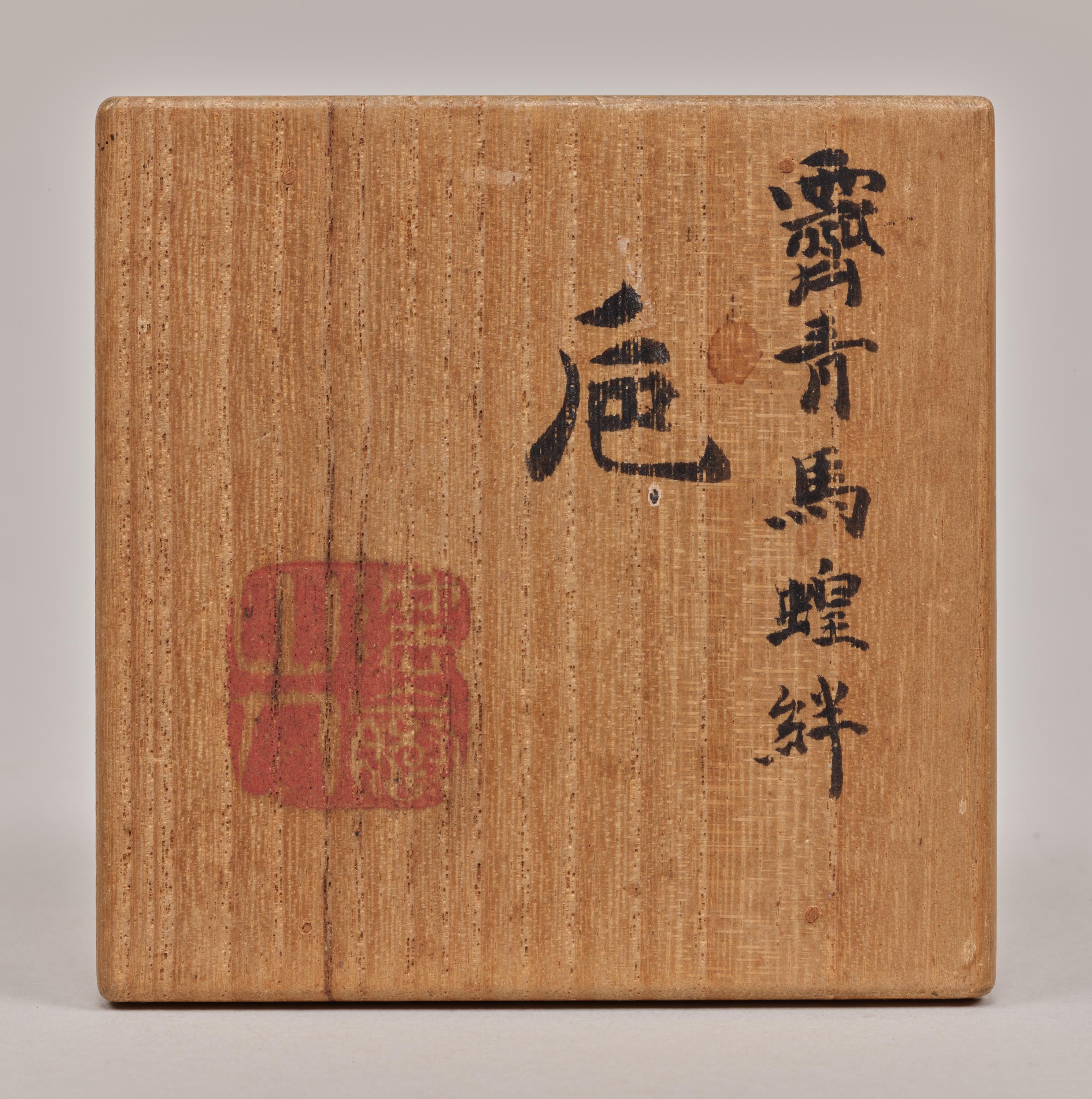
Who might the cup have been made for? Suminokura Gennei, also called Ippōdō, owned the original in the nineteenth century. The Kyoto City University of Arts museum records a tradition that he learned pottery from Dōhachi II and entrusted work at his kiln to the son. The museum report draws on an inscription on the box of another copy, at the Maspro Art Museum, to suggest Dōhachi II may have made the little cup for Gennei’s circle. The lid marked 巵 gives no customer’s name. Reading the two strokes as a means of recognising the original rests on the vessels and their inscriptions. Kyoto City University of Arts on Ippōdō and Dōhachi · The museum’s attribution of patronage
What did the witness of 1727 actually see?
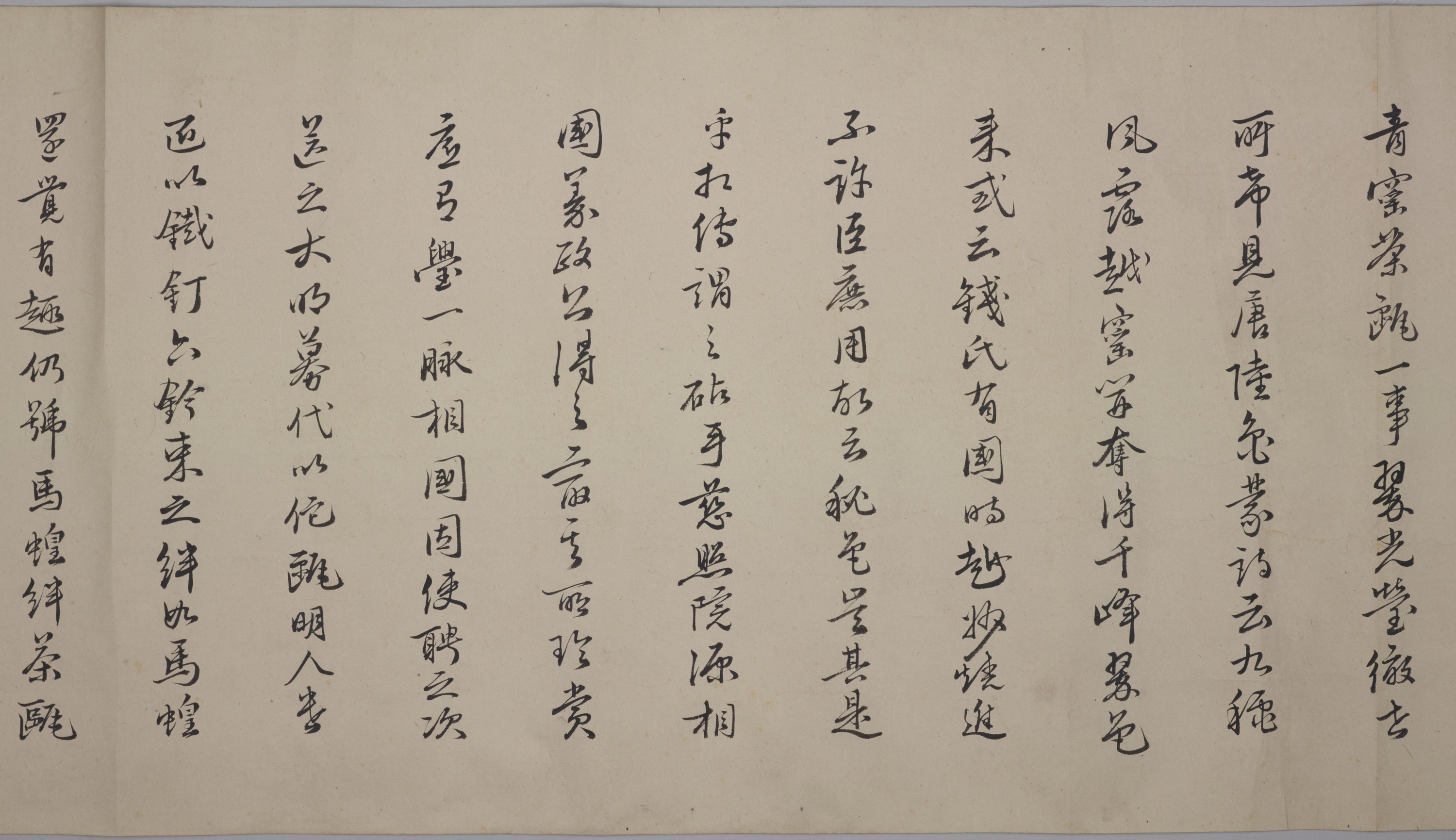
About a century before the Kyoto copies, the scholar Itō Tōgai saw the original at the Kyoto home of Suminokura Genkai. Near the end of the account he wrote in 1727 are the words 予得觀之, “I had the opportunity to see it.” A few lines earlier he tells how the fastenings lent the bowl an unexpected charm. The handwriting is the same throughout. The centuries to which the writer can bear witness are another matter. Tōgai’s manuscript · The text in his printed collected works
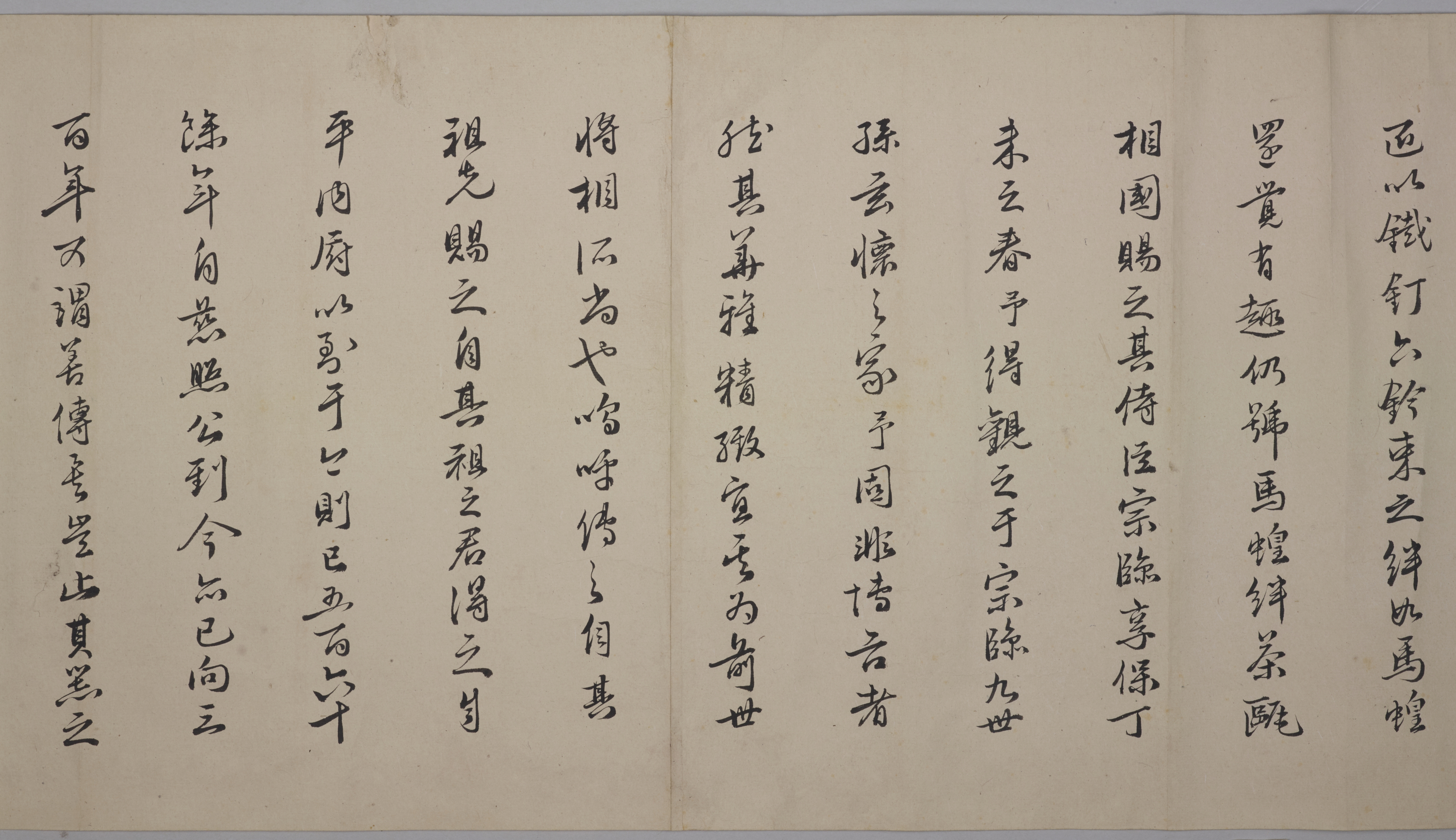
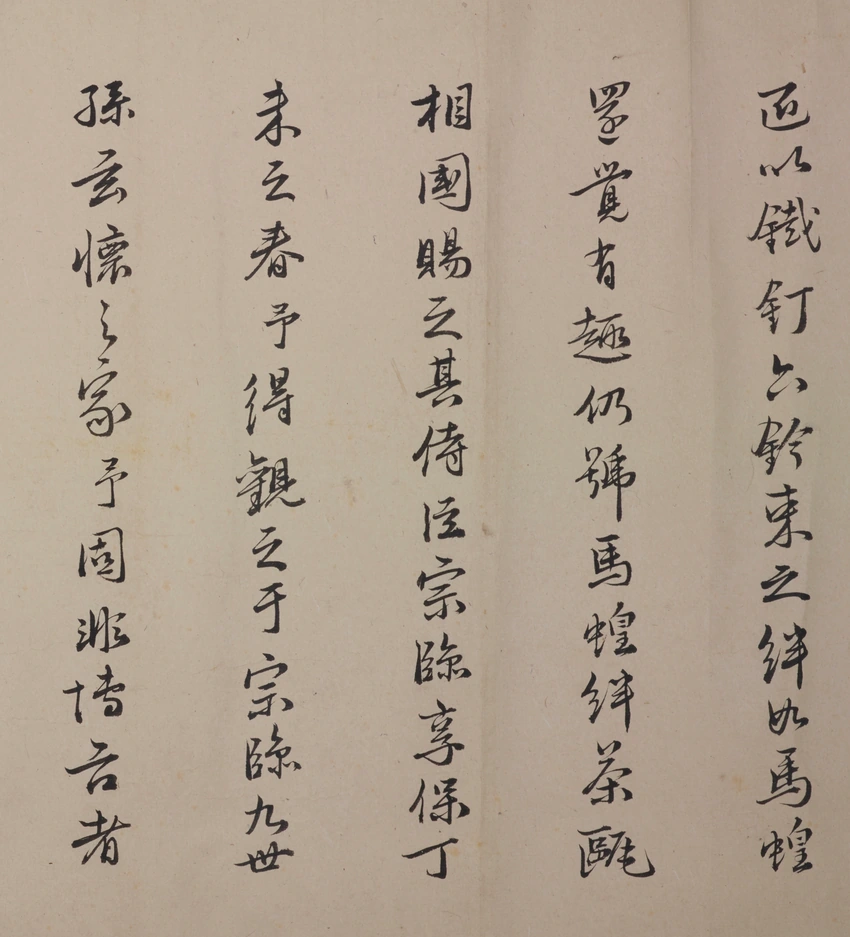
Read the columns from right to left. The account of the returned bowl gives way to Tōgai’s visit to Genkai’s house. Manuscript photograph, ColBase · Conclusion in print, National Archives of Japan
Tōgai relates that around 1175, Taira no Shigemori sent gold to the monastery on Mount Ayuwang in China. The monk Busshō sent this bowl in return. Centuries later, the shogun Ashikaga Yoshimasa sent the cracked bowl to Ming China to request a replacement. Craftsmen put in iron staples and sent it back. The shogun then gave it to Yoshida Sōrin. The familiar explanation that no comparable celadon could be found comes from the museum’s retelling. Tōgai’s passage gives no reason for the absence of a replacement. Book three of The Tale of the Heike also tells of Shigemori sending gold. The shipmaster Myōten is to provide for the purchase of land to support prayers after Shigemori’s death. No bowl is mentioned in that episode. Tōgai on the request · e-Museum account · The passage in the Heike
What do excavations tell us about the date? In Zhejiang, Hsieh Ming-liang points to a vase in a tomb dated 1195 with a glaze approaching plum green, and to mature celadons recalling Bakōhan in Lady Wu’s tomb of 1205. Imai also doubted a date in the 1170s for this bowl. Yet at the Dayao kilns in Longquan, Shen Yueming found thick, milky glazes in a layer dated as early as 1143. An earlier date for the technique still cannot tell us when any one bowl passed into Shigemori’s hands. Hsieh’s dated comparisons · Shen’s excavation evidence, fig. 10 · Imai’s dating
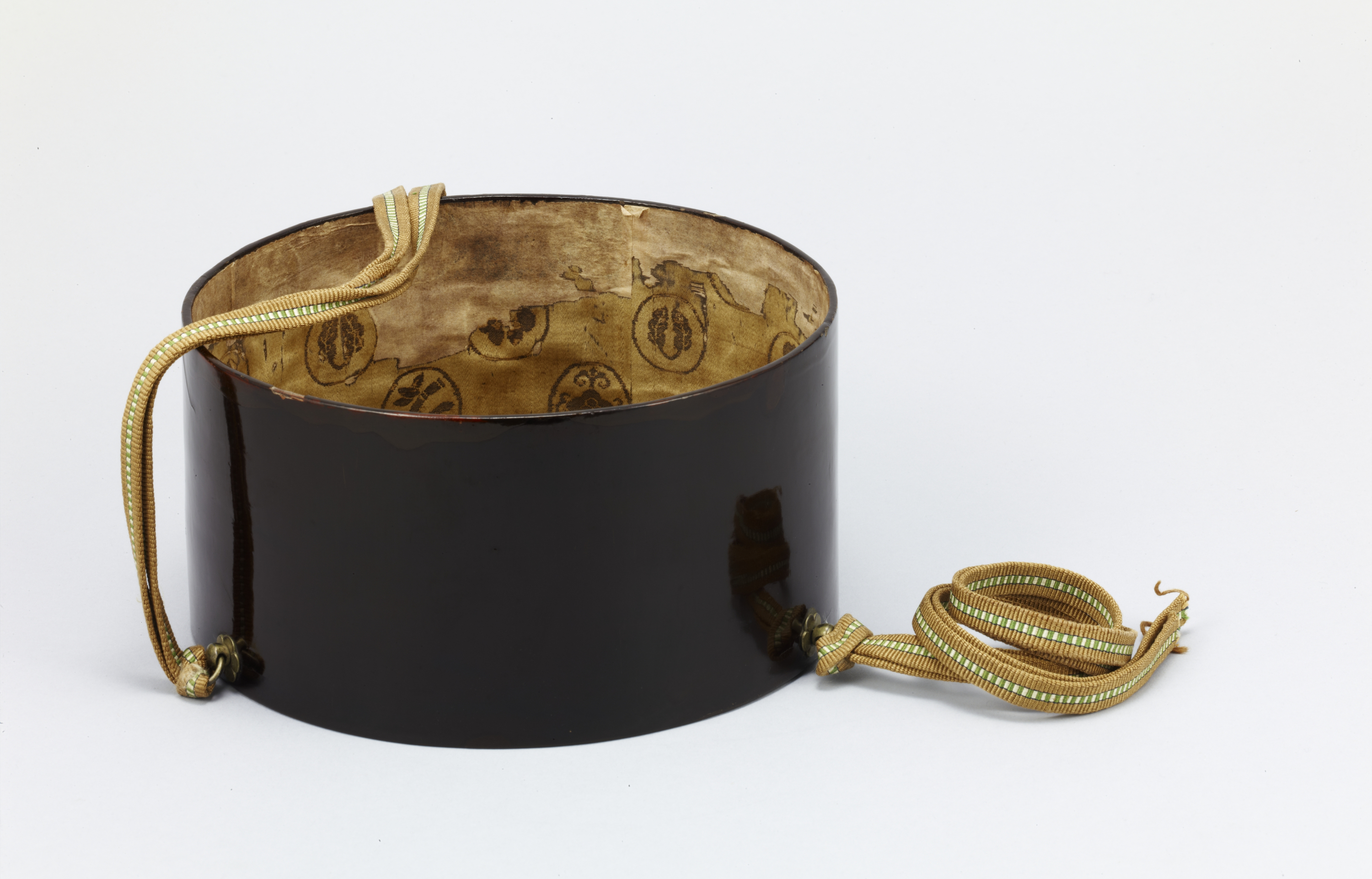
Yoshimasa’s part in the story is debated too. The e-Museum account gives the tradition some weight because the Suminokura family kept the bowl. The curator Mikasa Keiko observes that it cannot be identified in the shogunate’s inventories or in known tea records from the warring-states and Edo periods. The tradition may have grown within the family. The fitted case gives us something tangible. Imai found that the wear in the damask on the bottom of the black lacquered bentwood case, attributed to China, matched the diameter of the foot. Someone had a case made for this particular bowl. The wear gives us neither a workshop for the staples nor a name for the person who ordered them. e-Museum · Interview with Mikasa · Imai on the case
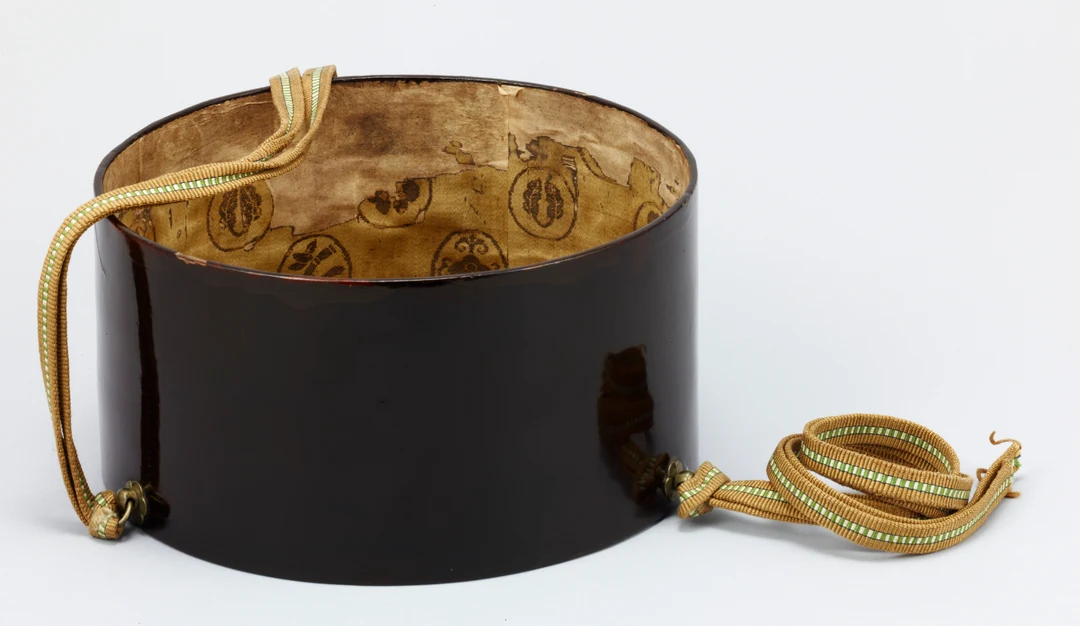
The original bowl’s case. The photograph shows the fabric at the side. The observation about wear on the bottom comes from Imai’s physical examination. Case photograph, ColBase
The locust, the leech and the word for a staple
The Tokyo National Museum explains the name as a likeness between the raised iron and a locust. Iwata Sumiko starts from a different use of the Chinese word 馬蝗. It can mean a leech, and an old Chinese play uses the creature as an image of something that clings tight. One reading picks out the arched body, the other the grip on the bowl. Museum explanation of the name · Iwata on the Chinese examples, pp. 6–7
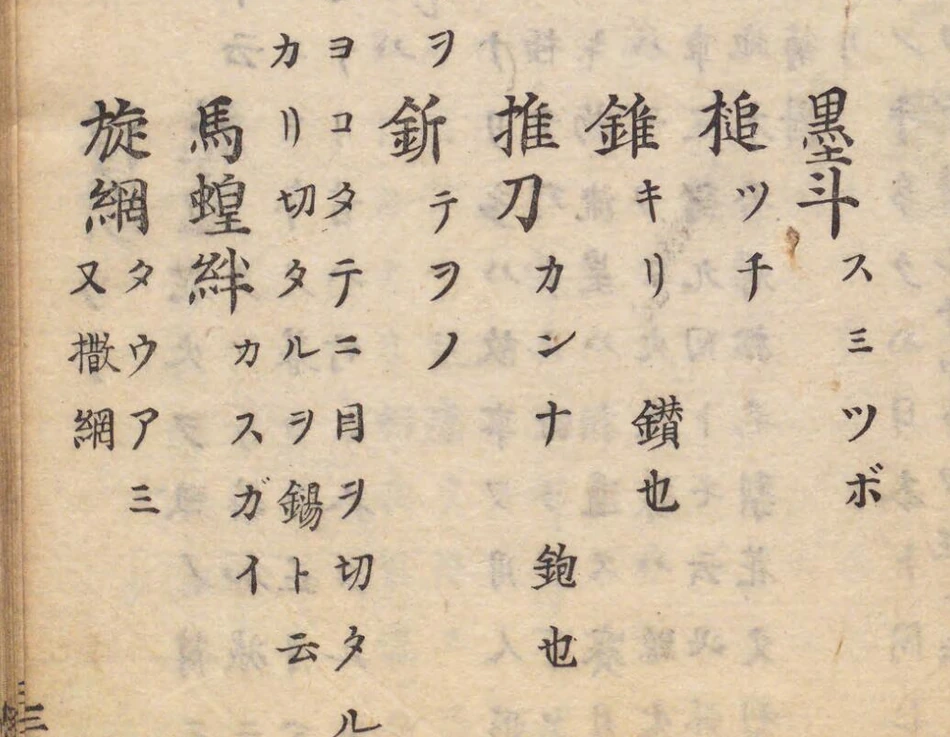
The tools section of the Shushi danki. Read the three characters together, then look immediately below for the small katakana. National Archives, vol. 4, frame 35 · The entry in a second copy
Nineteen years before Tōgai wrote his account, a Chinese–Japanese glossary printed in 1708, the Shushi danki, listed 馬蝗絆 with カスカイ, modern kasugai, a staple. Look for it among the awls and planes. Hsieh drew attention to this entry. It establishes that all three characters of the bowl’s name were already in use for the fitting itself. It does not identify the person who first gave the bowl its name. Image of the printed entry · Hsieh on the glossary, p. 14

In the very year Tōgai wrote, someone else wondered whether staples on a pot were a pleasure to look at. The entry for the twenty-ninth day of the third lunar month of 1727 in Yamashina Dōan’s Kaiki records Konoe Iehiro looking at a different celadon, a flower vase said to have belonged to Sen no Rikyū. Could the staples count as part of its keshiki, the features one looks at and admires? His question makes Dōhachi’s later decision to cut a crack into a new pot feel considerably less inevitable. The diary entry · Iwao’s research report, p. 3
We do have a date when someone prepared tea in the original bowl. On 19 March 1950, at Gokokuji temple in Tokyo, Kobori Sōkei used it to offer tea to the school’s founder, Kobori Enshū, at the ceremony marking his assumption of the name Sōkei. Mitsui Takahiro later gave the bowl to the Tokyo National Museum. Look inside it once more. From above, you see a line in the green glaze. The metal was doing its work just behind it. Dōhachi’s two brushstrokes on the sake cup mark a place you know once you have turned the tea bowl over. Enshū school account · The ceremony at Gokokuji · Museum gift record
Seeing the original. The Sen-oku Hakukokan Museum Tokyo in Roppongi lists Bakōhan for the second half of The Birth of Karamono, scheduled for 25 November to 13 December 2026. Exhibition checklist, p. 3 · Exhibition page
Select any figure to enlarge it. The object, case and manuscript photographs come from the Tokyo National Museum, via ColBase, National Institutes for Cultural Heritage. The historical photograph and examination come from the National Diet Library, the glossary from the National Archives of Japan. We cropped, resized and arranged the images for comparison. For a tea practitioner’s view of the foot, see our account of daitenmoku. Another bowl, Niji, has a surviving deed to set beside its stories. Examining the bowl and its stand · Niji and the deed of transfer