Even in wind and rain, we will not shelter under the gate. In the seventh month of 1404, two tea sellers outside the Great South Gate of Tōji in Kyoto gave the temple this written undertaking. They sold a bowl of tea for a single copper coin, a trade known as ippuku issen. To resume business they had to cross Kujō Avenue in front of the gate and sell their tea on its southern side. The undertaking of the twenty-third and its transcription, exhibit 57 · Bank of Japan Currency Museum on one-coin tea
Why move the sale of a bowl of tea a whole road’s width away? It began with a brazier that the sellers had left in someone else’s keeping. The dates below follow the calendar in use at the time.
Four promises before the fire
In the fourth month of the previous year, 1403, 道覚, Hachirōjirō (八郎次郎) and the widow of 道香 submitted an ukebumi, a written undertaking. The first restriction concerned where the three sellers lived. They promised to stay on the riverbank to the south as before, and never to move to the stone steps under the gate, even briefly. Original document from the fourth month of 1403
The other three clauses concern closing up shop and preparing hot water. They would leave no tea utensils in the room of an attendant of Hachimangū, the temple’s guardian shrine. They would take no embers to start their fire from the shrine or the temple halls. Nor would they draw water from the akai well at Kanjō-in, used for offerings to the Buddha. Breaking even one promise meant expulsion from the temple surroundings. Transcription of the four clauses, exhibit 53
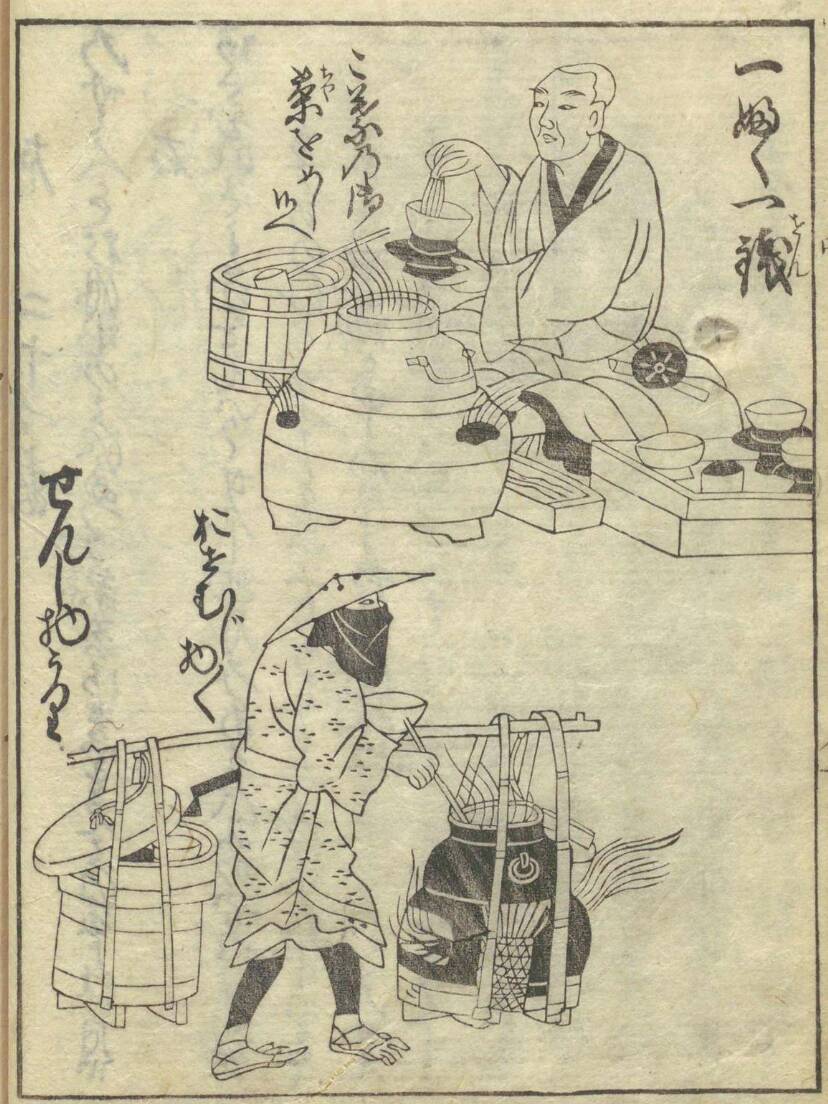
Match 24 in the Poetry Contest in Seventy-One Rounds, Komaba Library, University of Tokyo. Detail from the right side of frame 32 in the 1744 edition. See the complete spread · Catalogue entry
The figure above holds a bowl on a stand in the left hand, a combination familiar to anyone who practises daitenmoku. In the upper right is the occupational name 一服一銭. Steam rises from the kettle and a ladle peeps out of the water bucket. The figure below is a different trader, a seller of boiled infusions. This poetry contest paired the two trades around 1500, roughly a century after the sellers’ undertaking. With fire and water close at hand, the seller could whisk tea in a bowl on its stand. The picture helps place the four clauses in the working day. National Institute of Japanese Literature on the poetry contest · Bowl and stand in present-day practice
From the fire in the fourth month to the undertaking in the seventh
On the first day of the fourth month of 1404, a fire broke out beside the Great South Gate. It started among braziers and other belongings the tea sellers had left with someone described in the minutes as 乞食 (kotsujiki), a person living on alms. People gathered and put it out. Two days separated the fire from the decision to expel the sellers. At the right edge of the monks’ minutes, the register titled 廿一口方評定引付, the date is the third day of the fourth month. Reading left to the tea sellers’ case, one finds that the fire occurred on the first “of this month.” Minutes of the third, frame 14 · Transcription, exhibit 54
The sellers turned to the monk 以円, who held the title Wakasa Hōgen at Sanbō-in, Daigoji. A letter dated the twenty-second day of the fourth month survives. Its closing names 以円 as sender and 実相寺御坊 as recipient. The monk was forwarding the sellers’ petition to the Tōji side. The letter gives no year. The holding institution associates it with this incident. Text of the letter · Date, sender and addressee
When did the temple agree to let them reopen? The collection’s own account gives the twentieth day of the seventh month in the text and the twenty-sixth of the fourth month in the chronology. Between those dates, the sequence of minutes shows the monk intervening again. Kyoto Institute, Library and Archives on the early tea stalls
| Meeting date | What the original minutes show |
|---|---|
| Fourth month, day 26 | In the frame after 同廿六日, the right-hand page discusses the tea sellers outside the Great South Gate, the fire and expulsion, and how to answer the intermediary. Date · Discussion |
| Seventh month, day 9 | At the far left of the left-hand page, the item beginning 三宝院若狭法眼 records the monk raising the tea stall again. It continues at the far right of the next frame. Item and date · Continuation |
| Seventh month, day 20 | The heading reads 南大門茶屋事, “Tea stall at the Great South Gate.” Business is restricted to the south side of the avenue and the sellers must submit a written undertaking. Date · Decision |
The date we can establish for conditional permission to reopen south of the avenue is the twentieth day of the seventh month. Three days later the widow and Hachirōjirō submitted their new undertaking. The previous year’s document writes the deceased husband’s name 道香, this one 道幸. 道覚 does not appear. Nothing here dates the first bowl sold after reopening. Undertaking with both signatures
Where could they keep the brazier?
After specifying the south side of the road, the new undertaking spells out where the brazier could go. Neither it nor other equipment was to be brought under the gate or into the shelter of the earthen wall, even briefly. Nothing was to be left inside the temple or entrusted to people living on alms. The sellers would not take shelter under the gate or wall in wind and rain or walk in and out of the temple without cause. The previous year the temple had specified their homes. Now it prescribed where they traded and where they might shelter in a sudden shower. Original undertaking · Transcription of the three clauses
A breach meant punishment for the individual and expulsion for the stall. In that event, they also promised not to ask a powerful household (権門勢家) to intercede with the temple. The kind of intervention that had helped them reopen would no longer be available. Penalties at the end of the undertaking
How far from the gate was “south of the avenue”? Fifty-seven years later, in 1461, fields were encroaching on Kujō Avenue. Tōji drove boundary stakes along its southern edge. The second line from the right reads 九條大路廣十二丈, giving the road’s width as twelve jō, roughly 36 metres. Further left are the words 九本, nine stakes. The sellers’ undertaking gives no distance, but this later record helps us picture the crossing. Record of the stakes, box ホ, no. 53 · Kyoto Prefectural Library and Archives on the temple gate, p. 4
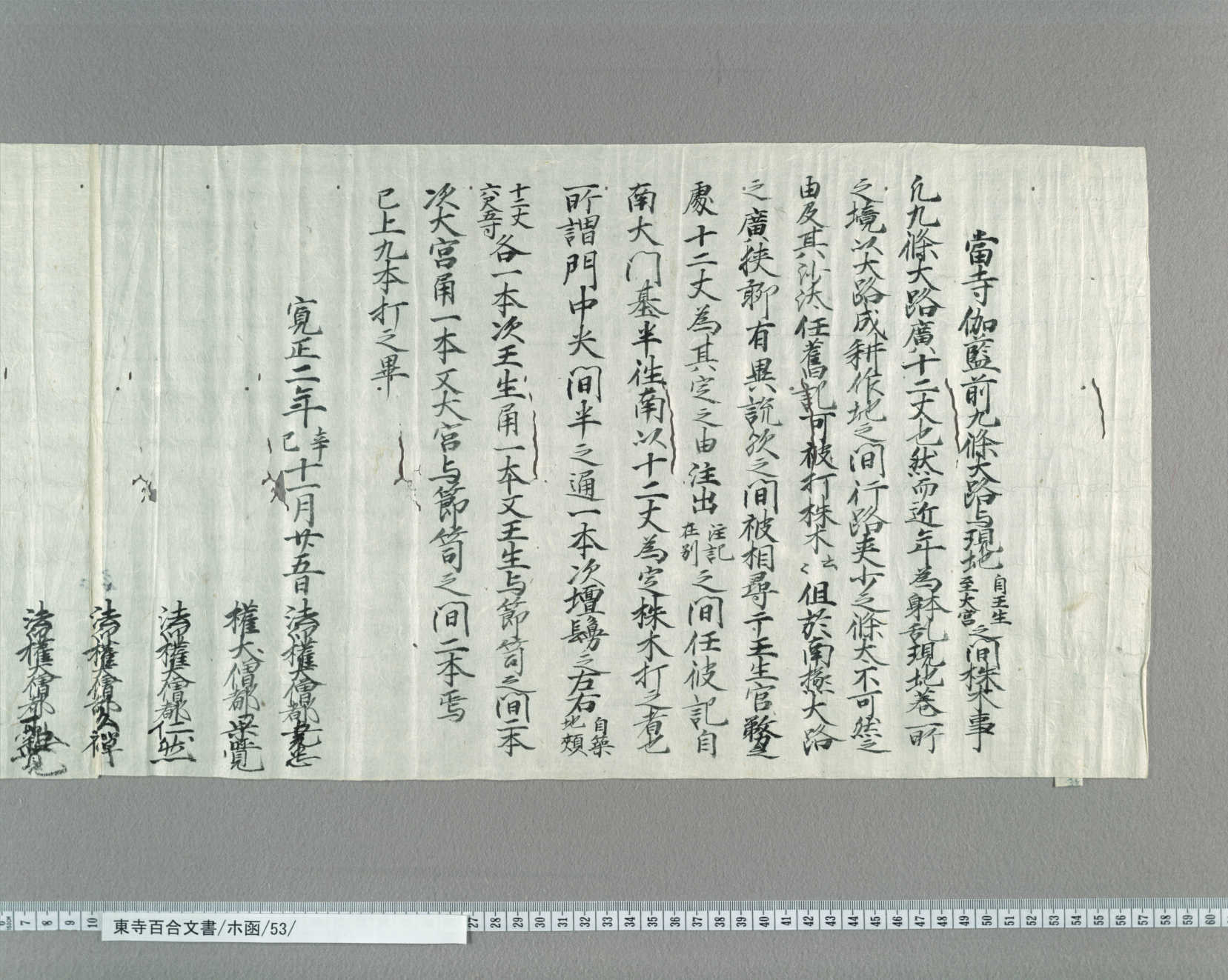
One of nine stakes, directly opposite the gate. Follow the right-hand line down from 南大門 to 十二丈. In the next line 門中央 and 一本 place one stake opposite the middle bay of the gate. Detail from the Tōji Hyakugō Documents, Kyoto Institute, Library and Archives. Whole sheet, box ホ, no. 53 · CC BY 2.1 JP
Two undertakings, from the people who left the utensils and the person asked to keep them
Who kept the utensils after the stall closed? Tōji secured promises from both sides. In these two details, read the vertical lines from right to left and look for 宮仕部屋, the shrine attendant’s room, and 茶具足, the tea equipment.
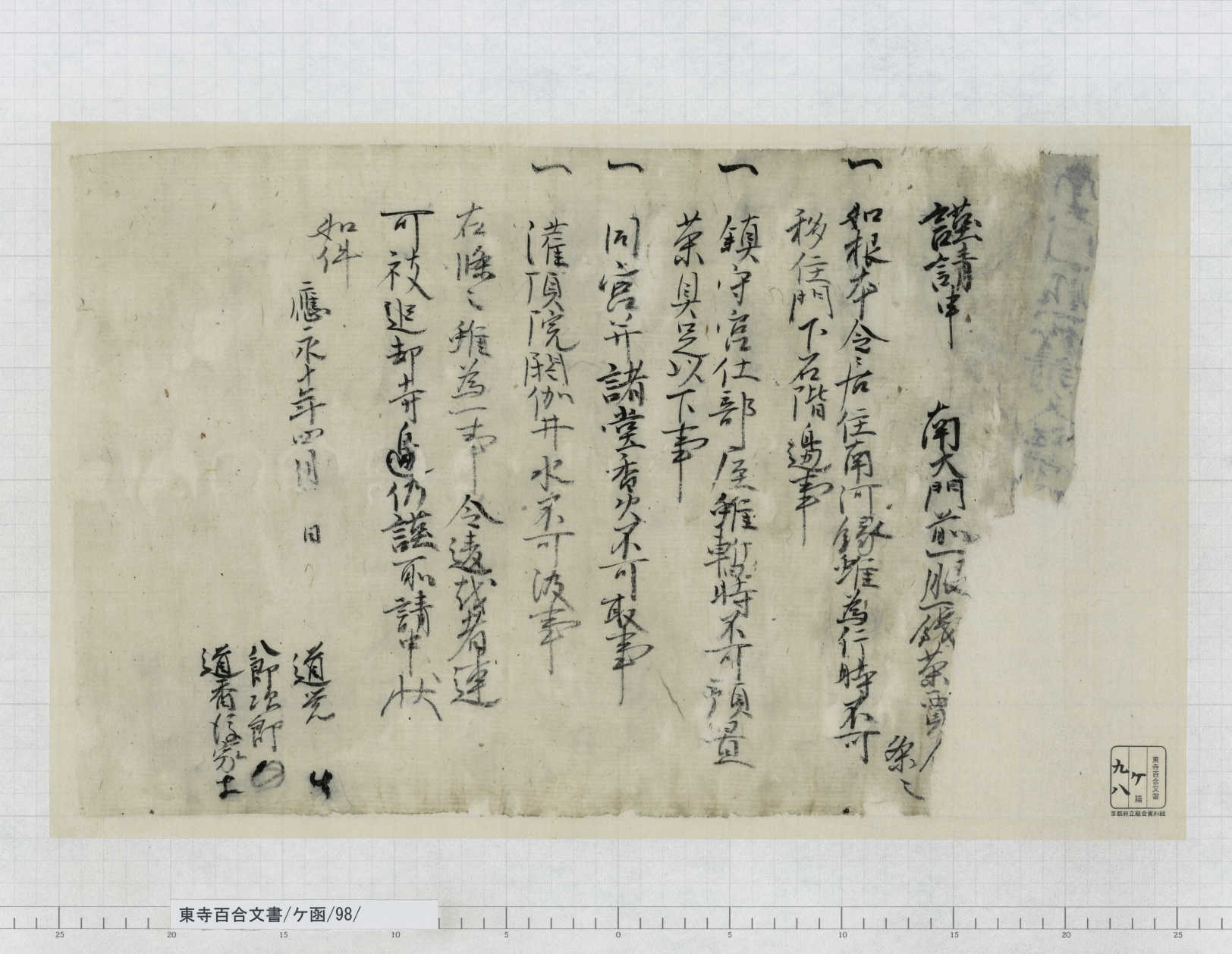
The sellers’ promise, 1403. 鎮守宮仕部屋 on the right names the room where something might be left. 茶具足 on the left identifies the tea equipment. 雖暫時 adds “even for a moment.” Complete document, box ケ, no. 98
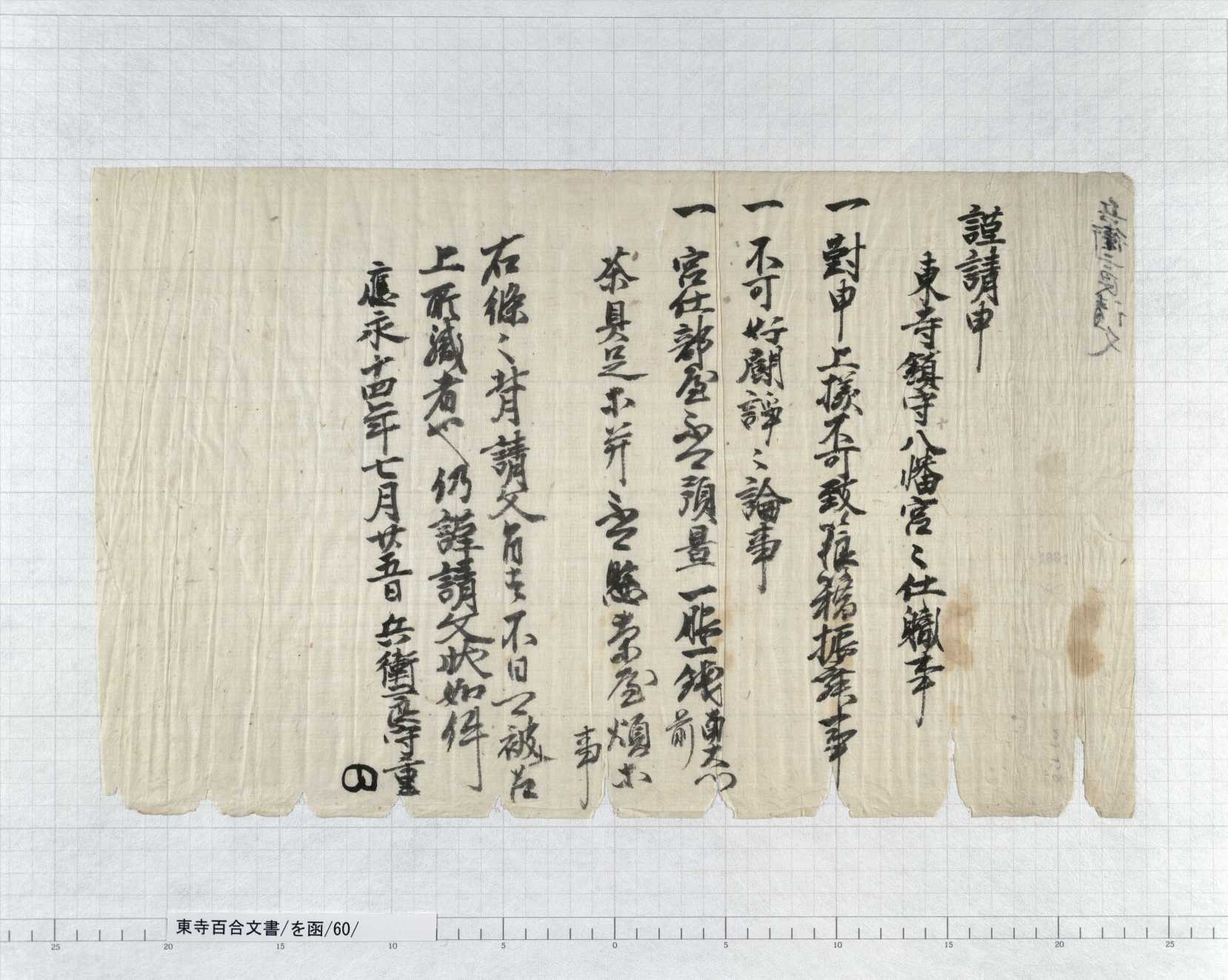
The attendant’s promise, 1407. Beside 一服一銭 on the right is the small note 南大門前, “in front of the Great South Gate.” Continue to 茶具足 at the top of the next line. The Hachimangū attendant 兵衛二良守重 also swore not to keep these sellers’ equipment in his room. Complete document, box を, no. 60
Both details come from the Tōji Hyakugō Documents at the Kyoto Institute, Library and Archives. Select either image to open the whole sheet, including the signature. Collection’s terms of use · CC BY 2.1 JP
Sellers who broke their promise would be driven from the gate. An attendant who broke his would lose his post. For the trader leaving the equipment and for the attendant responsible for the room, storing it there could mean losing their livelihood. Closing lines of the attendant’s undertaking
In 1411 another tea merchant, the novice 浄音, pledged to sweep both sides of the Great South Gate every day. In 1421 the third clause of a new attendant’s undertaking again mentions 一服一銭 and 茶具足. The new attendant, 橘国継, does not name the two sellers. Yet the rule against keeping their kind of equipment passed to the next person entrusted with the room. The novice’s undertaking, box や, no. 54 · The new attendant’s undertaking, box を, no. 97